Skip to main content
Financial Accounting
My Course
Learn
Exam Prep
AI Tutor
Study Guides
Flashcards
Explore
Try the app
My Course
Learn
Exam Prep
AI Tutor
Study Guides
Flashcards
Explore
Try the app
Back
GAAP vs. IFRS: Classified Balance Sheet definitions
You can tap to flip the card.
GAAP
You can tap to flip the card.
👆
GAAP
U.S. accounting standards set by FASB, emphasizing historical cost and a specific balance sheet format.
Track progress
Control buttons has been changed to "navigation" mode.
1/15
Related flashcards
Related practice
Recommended videos
GAAP vs. IFRS: Classified Balance Sheet quiz #1
GAAP vs. IFRS: Classified Balance Sheet
10 Terms
GAAP vs. IFRS: Classified Balance Sheet
15. GAAP vs IFRS
10 problems
Topic
GAAP vs. IFRS: Recording Differences
15. GAAP vs IFRS
10 problems
Topic
15. GAAP vs IFRS
13 topics
13 problems
Chapter
Guided course
06:27
GAAP vs. IFRS: Classified Balance Sheet
520
views
14
rank
Terms in this set (15)
Hide definitions
GAAP
U.S. accounting standards set by FASB, emphasizing historical cost and a specific balance sheet format.
IFRS
International accounting standards set by IASB, allowing asset revaluation and using different balance sheet terminology.
FASB
U.S. organization responsible for establishing and updating generally accepted accounting principles.
IASB
International body that develops and issues global accounting standards for financial reporting.
Classified Balance Sheet
Financial statement dividing assets and liabilities into current and long-term categories using a one-year threshold.
Statement of Financial Position
IFRS term for the balance sheet, typically listing equity before liabilities and assets in reverse liquidity order.
Historical Cost Principle
Accounting guideline requiring assets to be recorded at their original purchase price, ensuring consistency over time.
Fair Value Principle
IFRS guideline allowing assets to be updated to reflect current market values, resulting in more frequent valuation changes.
Current Assets
Resources expected to be converted to cash or used up within one year, such as cash and receivables.
Long-term Assets
Resources expected to provide economic benefit beyond one year, including equipment and long-term investments.
Current Liabilities
Obligations due within one year, such as accounts payable and short-term loans.
Long-term Liabilities
Obligations not due within the next year, including bonds payable and long-term loans.
Equity
Residual interest in assets after deducting liabilities, often presented before liabilities under IFRS.
Liquidity
Measure of how quickly assets can be converted to cash, with IFRS listing assets in reverse order of this characteristic.
Share Investments
IFRS term for investments in other companies' shares, equivalent to 'investments' under GAAP.
 BackBack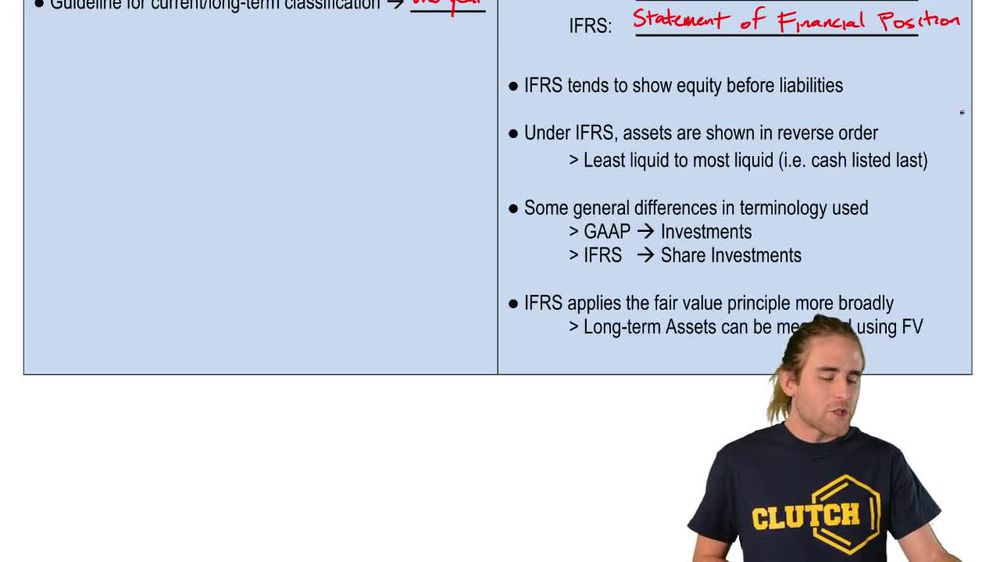
 06:27
06:27