Skip to main content
Financial Accounting
My Course
Learn
Exam Prep
AI Tutor
Study Guides
Flashcards
Explore
Try the app
My Course
Learn
Exam Prep
AI Tutor
Study Guides
Flashcards
Explore
Try the app
Back
GAAP vs. IFRS: Fraud, Internal Controls, and Cash definitions
You can tap to flip the card.
GAAP
You can tap to flip the card.
👆
GAAP
A set of accounting standards established by a US board, guiding financial reporting for American companies.
Track progress
Control buttons has been changed to "navigation" mode.
1/14
Related flashcards
Related practice
Recommended videos
GAAP vs. IFRS: Fraud, Internal Controls, and Cash quiz
GAAP vs. IFRS: Fraud, Internal Controls, and Cash
15 Terms
GAAP vs. IFRS: Fraud, Internal Controls, and Cash
15. GAAP vs IFRS
10 problems
Topic
GAAP vs. IFRS: Receivables
15. GAAP vs IFRS
10 problems
Topic
15. GAAP vs IFRS
11 topics
11 problems
Chapter
Guided course
03:03
GAAP vs. IFRS: Fraud, Internal Controls, and Cash
463
views
3
rank
Terms in this set (14)
Hide definitions
GAAP
A set of accounting standards established by a US board, guiding financial reporting for American companies.
IFRS
A global framework for financial reporting, developed by an international board, used outside the United States.
Financial Accounting Standards Board
The US organization responsible for creating and updating the primary accounting rules followed domestically.
International Accounting Standards Board
The international body that develops and issues accounting standards used in many countries worldwide.
Internal Controls
Procedures and policies within organizations designed to safeguard assets and prevent fraudulent activities.
Fraud
Intentional deception or misrepresentation in financial activities, often leading to financial loss or misstatement.
Bank Reconciliation
A process comparing company records with bank statements to ensure accuracy and detect discrepancies.
Cash
Funds available for immediate use, typically including currency, coins, and balances in checking accounts.
Cash Equivalents
Highly liquid investments with maturities of less than 90 days, considered nearly as accessible as cash.
Sarbanes-Oxley Act
A US law enacted to strengthen internal controls and financial reporting after major corporate scandals.
Financial Reporting
The process of disclosing financial data to stakeholders, ensuring transparency and accountability.
US Stock Exchange
A marketplace where shares of publicly traded US companies are bought and sold, subject to specific regulations.
Accounting Scandal
A major event involving fraudulent or unethical financial reporting, often leading to regulatory changes.
Public Company
A business entity whose shares are traded on a stock exchange and must adhere to strict reporting standards.
 BackBack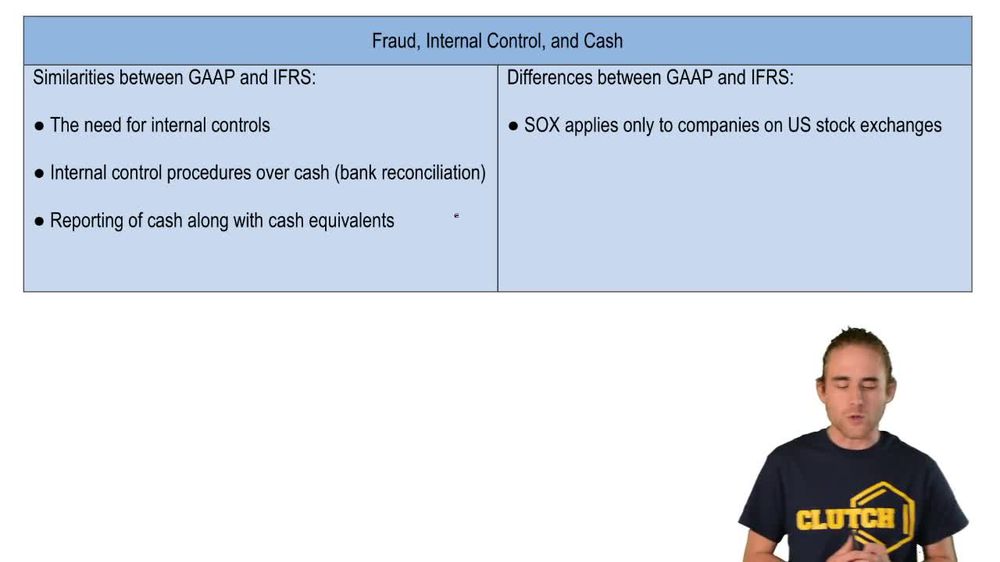
 03:03
03:03