Skip to main content
Financial Accounting
My Course
Learn
Exam Prep
AI Tutor
Study Guides
Flashcards
Explore
Try the app
My Course
Learn
Exam Prep
AI Tutor
Study Guides
Flashcards
Explore
Try the app
Back
GAAP vs. IFRS: Long Lived Assets definitions
You can tap to flip the card.
GAAP
You can tap to flip the card.
👆
GAAP
US-based accounting framework established by the Financial Accounting Standards Board, guiding financial reporting and asset treatment.
Track progress
Control buttons has been changed to "navigation" mode.
1/15
Related flashcards
Related practice
Recommended videos
GAAP vs. IFRS: Long Lived Assets quiz
GAAP vs. IFRS: Long Lived Assets
15 Terms
GAAP vs. IFRS: Long Lived Assets
15. GAAP vs IFRS
10 problems
Topic
GAAP vs. IFRS: Liabilities
15. GAAP vs IFRS
9 problems
Topic
15. GAAP vs IFRS
11 topics
11 problems
Chapter
Guided course
05:02
GAAP vs. IFRS: Long-Lived Assets
450
views
4
rank
Terms in this set (15)
Hide definitions
GAAP
US-based accounting framework established by the Financial Accounting Standards Board, guiding financial reporting and asset treatment.
IFRS
International accounting standards set by the International Accounting Board, used globally for financial reporting and asset valuation.
Long-lived Assets
Resources such as property, plant, equipment, and intangibles expected to provide economic benefits over multiple years.
Historical Cost Principle
Accounting rule requiring assets to be recorded at their original purchase price at the time of acquisition.
Property, Plant, and Equipment
Tangible long-term resources like land, buildings, and machinery used in business operations.
Intangibles
Non-physical assets such as patents, trademarks, and copyrights that provide future economic benefits.
Ordinary Repairs
Routine maintenance expenditures that are immediately expensed and do not extend an asset's useful life.
Capital Improvements
Expenditures that increase an asset's value or useful life and are added to the asset's recorded cost.
Depreciation Methods
Approaches for allocating the cost of a tangible asset over its useful life, including straight line and double declining.
Salvage Value
Estimated amount expected to be recovered at the end of an asset's useful life under GAAP.
Residual Value
Term used in IFRS for the expected remaining value of an asset after its useful life.
Fair Value Principle
IFRS concept allowing assets to be revalued to current market value after initial recognition.
Component Depreciation
IFRS practice of depreciating separate parts of an asset individually when they have different useful lives.
Research and Development Costs
Expenditures related to innovation; always expensed under GAAP, but may be capitalized in IFRS after technological feasibility.
Non-monetary Exchanges
Transactions involving the trade of assets without cash, such as swapping equipment, treated similarly under both standards.
 BackBack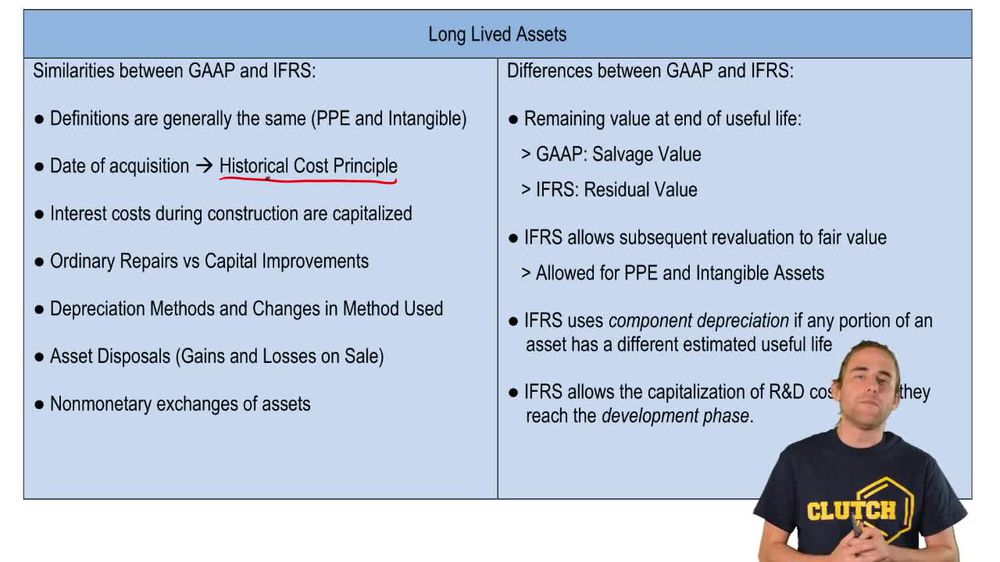
 05:02
05:02