Skip to main content
Financial Accounting
My Course
Learn
Exam Prep
AI Tutor
Study Guides
Flashcards
Explore
Try the app
My Course
Learn
Exam Prep
AI Tutor
Study Guides
Flashcards
Explore
Try the app
Back
GAAP vs. IFRS: Receivables definitions
You can tap to flip the card.
GAAP
You can tap to flip the card.
👆
GAAP
A set of accounting standards used in the US, established by the Financial Accounting Standards Board, emphasizing strict account titles.
Track progress
Control buttons has been changed to "navigation" mode.
1/14
Related flashcards
Related practice
Recommended videos
GAAP vs. IFRS: Receivables quiz
GAAP vs. IFRS: Receivables
15 Terms
GAAP vs. IFRS: Receivables
15. GAAP vs IFRS
10 problems
Topic
GAAP vs. IFRS: Long Lived Assets
15. GAAP vs IFRS
10 problems
Topic
15. GAAP vs IFRS
11 topics
11 problems
Chapter
Guided course
02:42
GAAP vs. IFRS: Receivables
407
views
3
rank
Terms in this set (14)
Hide definitions
GAAP
A set of accounting standards used in the US, established by the Financial Accounting Standards Board, emphasizing strict account titles.
IFRS
A global set of accounting standards created by the International Accounting Standards Board, focusing on transparency over strict account titles.
Financial Accounting Standards Board
The US organization responsible for developing and maintaining the rules that comprise GAAP.
International Accounting Standards Board
The international body that sets and updates IFRS for use outside the US.
Receivables
Amounts owed to a business by customers, typically arising from sales made on credit.
Allowance for Doubtful Accounts
A contra-asset account estimating the portion of receivables unlikely to be collected.
Impairment of Receivables
A reduction in the value of receivables when collection is considered unlikely, reflecting potential bad debts.
Sales Returns
Amounts credited to customers for returned goods, reducing total receivables.
Allowances
Reductions in receivables for issues like damaged goods or pricing errors, separate from returns.
Discounts
Deductions from receivable amounts offered to customers for early payment or other incentives.
Factoring
The process of selling receivables to a third party to obtain immediate cash, transferring collection risk.
Account Titles
Specific names assigned to accounts in financial records, with GAAP requiring more precision than IFRS.
Transparency
The principle of providing clear and understandable financial information, emphasized under IFRS.
Bad Debts
Receivable amounts deemed uncollectible, often leading to impairment or write-off.
 BackBack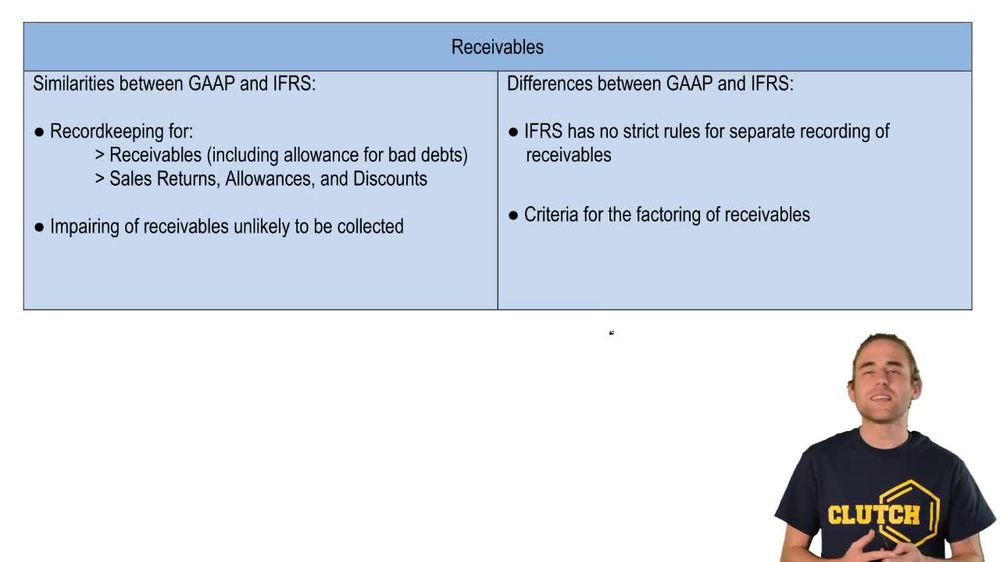
 02:42
02:42