Skip to main content
Financial Accounting
My Course
Learn
Exam Prep
AI Tutor
Study Guides
Flashcards
Explore
Try the app
My Course
Learn
Exam Prep
AI Tutor
Study Guides
Flashcards
Explore
Try the app
Back
Held-to-Maturity (HTM) Securities definitions
You can tap to flip the card.
Held-to-Maturity Investments
You can tap to flip the card.
👆
Held-to-Maturity Investments
Debt securities acquired with the intent and ability to hold until maturity, reported at amortized cost on the balance sheet.
Track progress
Control buttons has been changed to "navigation" mode.
1/15
Related flashcards
Related practice
Recommended videos
Held-to-Maturity (HTM) Securities quiz #1
Held-to-Maturity (HTM) Securities
10 Terms
Held-to-Maturity (HTM) Securities
7. Receivables and Investments
10 problems
Topic
Equity Method
7. Receivables and Investments
10 problems
Topic
7. Receivables and Investments - Part 1 of 2
10 topics
15 problems
Chapter
7. Receivables and Investments - Part 2 of 2
1 topic
3 problems
Chapter
Guided course
03:45
Discount on Bonds Receivable
460
views
7
rank
Guided course
03:02
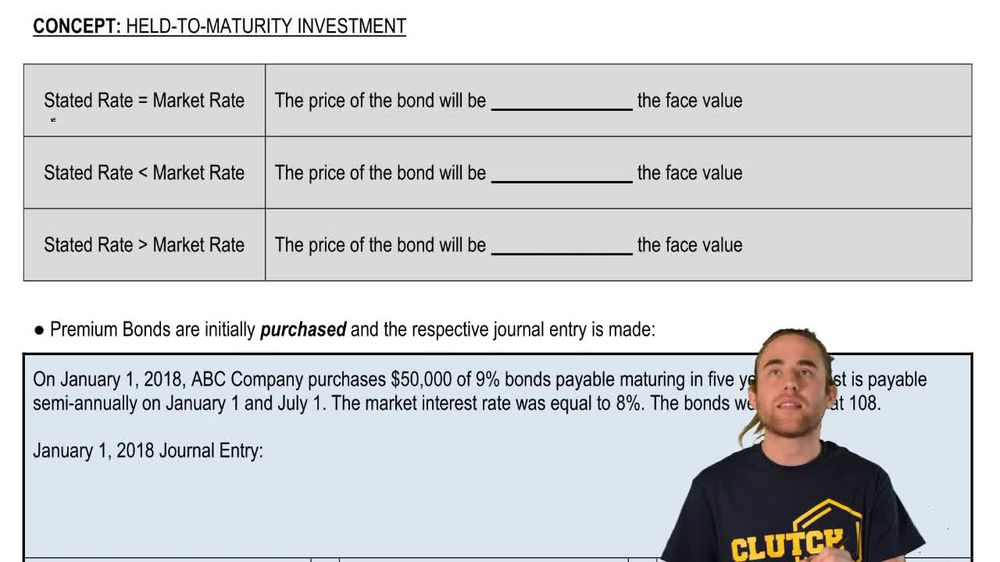
Stated Rate vs. Market Rate for Held-to-Maturity Investments
560
views
10
rank
Guided course
04:53
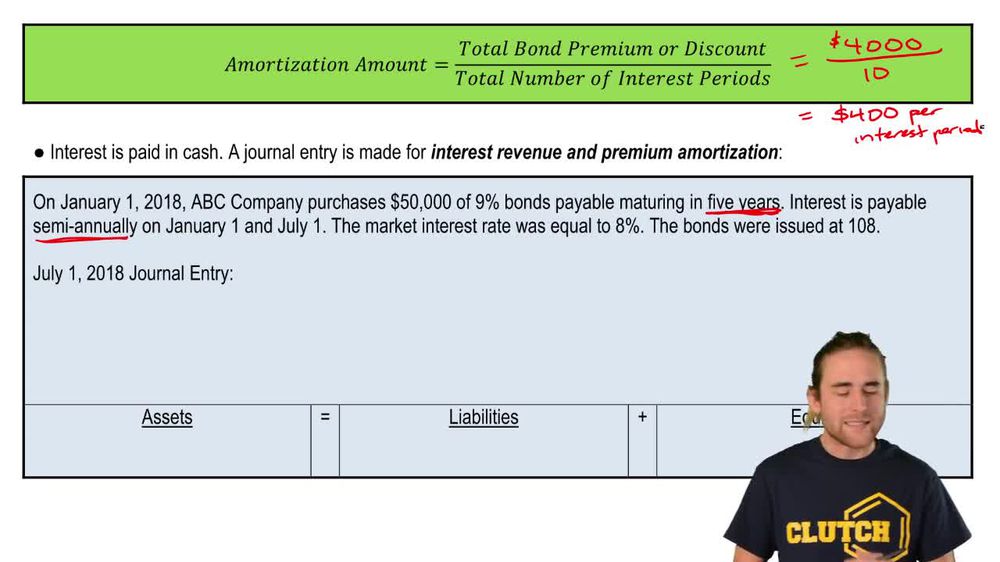
Premium on Bonds Receivable
435
views
6
rank
Terms in this set (15)
Hide definitions
Held-to-Maturity Investments
Debt securities acquired with the intent and ability to hold until maturity, reported at amortized cost on the balance sheet.
Principal Amount
Face value of a bond, representing the sum to be repaid to the investor at maturity, regardless of purchase price.
Stated Rate
Interest rate specified on the bond, used to calculate periodic interest payments to the bondholder.
Market Rate
Prevailing interest rate in the market for similar bonds, influencing a bond's selling price as premium or discount.
Premium
Excess of a bond's purchase price over its principal, arising when the stated rate exceeds the market rate.
Discount
Shortfall of a bond's purchase price below its principal, occurring when the stated rate is less than the market rate.
Amortization
Systematic allocation of premium or discount over the bond's life, adjusting the investment's book value to principal at maturity.
Straight-Line Method
Technique dividing total premium or discount evenly across all interest periods, simplifying amortization calculations.
Bonds Receivable
Asset account recording the principal amount of bonds owned by an investor, separate from any premium or discount.
Interest Revenue
Income recognized from earning interest on bonds, including both cash received and amortized premium or discount.
Semiannual Interest
Interest payments made twice a year, requiring division of annual stated rate by two for each payment calculation.
Amortized Cost
Carrying value of an investment after adjusting for cumulative amortization of premium or discount.
Journal Entry
Accounting record documenting transactions such as bond purchases, interest receipts, and amortization adjustments.
Net Assets
Total assets minus total liabilities, affected by changes in investment values and interest revenue recognition.
Balance Sheet
Financial statement presenting assets, liabilities, and equity, including held-to-maturity investments at amortized cost.
 BackBack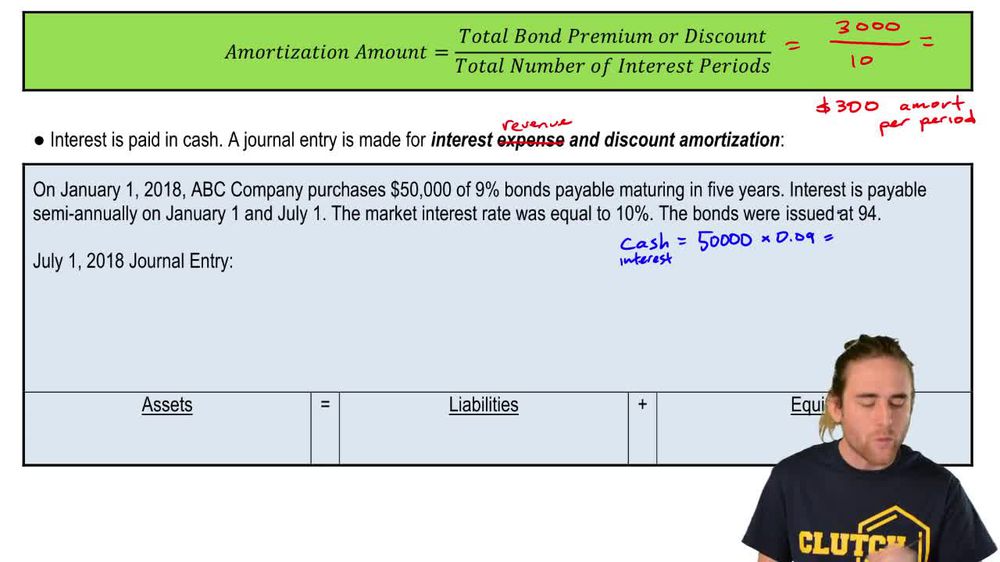
 03:45
03:45