Skip to main content
Financial Accounting
My Course
Learn
Exam Prep
AI Tutor
Study Guides
Flashcards
Explore
Try the app
My Course
Learn
Exam Prep
AI Tutor
Study Guides
Flashcards
Explore
Try the app
Back
Limitations of Internal Controls definitions
You can tap to flip the card.
Internal Controls
You can tap to flip the card.
👆
Internal Controls
Systems designed to prevent or detect fraud and ensure the safeguarding of assets and reliability of financial information.
Track progress
Control buttons has been changed to "navigation" mode.
1/15
Related flashcards
Related practice
Recommended videos
Limitations of Internal Controls quiz #1
Limitations of Internal Controls
10 Terms
Limitations of Internal Controls
6. Internal Controls and Reporting Cash
10 problems
Topic
Petty Cash
6. Internal Controls and Reporting Cash
10 problems
Topic
6. Internal Controls and Reporting Cash
8 topics
15 problems
Chapter
Guided course
03:59
Limitations of Internal Controls
1349
views
51
rank
Terms in this set (15)
Hide definitions
Internal Controls
Systems designed to prevent or detect fraud and ensure the safeguarding of assets and reliability of financial information.
Fraud
Intentional deception or misappropriation of company resources, often targeted by internal control systems.
Human Error
Mistakes or oversights by employees that can undermine the effectiveness of established procedures.
Carelessness
Lack of attention or diligence by staff, potentially leading to the failure of control measures.
Indifference
Employee attitude of disregard toward procedures, reducing the effectiveness of internal controls.
Collusion
Cooperation between two or more employees to bypass controls and commit fraud, defeating separation of duties.
Separation of Duties
Division of responsibilities among employees to reduce the risk of error or fraud.
Executive Override
Ability of high-level management to bypass controls, often by authorizing their own transactions.
CFO
Top financial executive who may have authority to approve transactions without additional oversight.
Small Business
Organization with limited staff, making it challenging to implement effective separation of duties.
Cost-Benefit Analysis
Evaluation of whether the expense of implementing controls is justified by the potential reduction in fraud risk.
Trustworthiness
Reliability and integrity of employees, a factor considered when deciding on the extent of controls.
Reasonable Assurance
Level of confidence provided by controls, indicating a high but not absolute likelihood of achieving objectives.
Safeguarding of Assets
Protection of company resources from loss, theft, or misuse through internal control measures.
Reliability of Financial Information
Confidence that reported financial data accurately reflects the company's true financial position.
 BackBack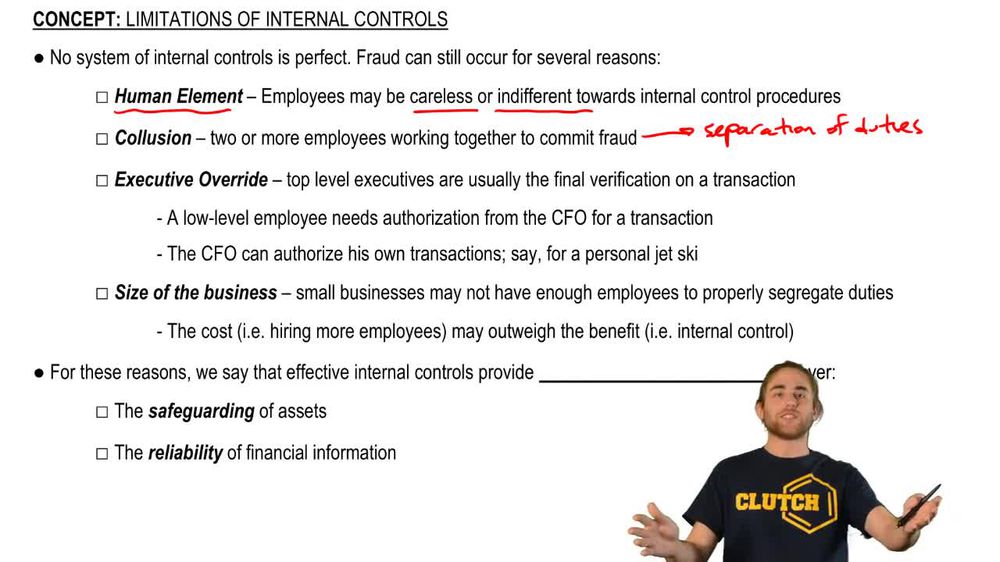
 03:59
03:59