Skip to main content
Financial Accounting
My Course
Learn
Exam Prep
AI Tutor
Study Guides
Flashcards
Explore
Try the app
My Course
Learn
Exam Prep
AI Tutor
Study Guides
Flashcards
Explore
Try the app
Back
Perpetual Inventory - FIFO, LIFO, and Average Cost definitions
You can tap to flip the card.
Perpetual Inventory System
You can tap to flip the card.
👆
Perpetual Inventory System
A method where inventory records are updated continuously after each purchase or sale, reflecting real-time inventory levels.
Track progress
Control buttons has been changed to "navigation" mode.
1/13
Related flashcards
Related practice
Recommended videos
Perpetual Inventory - FIFO, LIFO, and Average Cost quiz
Perpetual Inventory - FIFO, LIFO, and Average Cost
15 Terms
Perpetual Inventory - FIFO, LIFO, and Average Cost
5. Inventory
5 problems
Topic
Financial Statement Effects of Inventory Costing Methods
5. Inventory
10 problems
Topic
5. Inventory - Part 1 of 2
6 topics
13 problems
Chapter
5. Inventory - Part 2 of 2
1 topic
3 problems
Chapter
Guided course
10:12
Perpetual Inventory Average Cost
2144
views
37
rank
1
comments
Guided course
09:44
Perpetual Inventory FIFO
2790
views
50
rank
Guided course
07:15
Perpetual Inventory LIFO
1790
views
46
rank
Terms in this set (13)
Hide definitions
Perpetual Inventory System
A method where inventory records are updated continuously after each purchase or sale, reflecting real-time inventory levels.
FIFO
A cost flow assumption where the oldest inventory units are considered sold first, impacting cost of goods sold with earlier purchase prices.
LIFO
A cost flow assumption where the newest inventory units are considered sold first, causing cost of goods sold to reflect recent purchase prices.
Average Cost Method
A technique that allocates cost of goods sold based on the average cost of all units available, recalculated after each transaction.
Moving Average
A recalculated average cost per unit in a perpetual system, updated after every inventory purchase or sale.
Cost Flow Assumption
An accounting approach that determines which inventory costs are assigned to cost of goods sold and ending inventory.
Cost of Goods Sold
The total cost assigned to inventory items that have been sold during a period, based on the chosen cost flow method.
Physical Flow of Goods
The actual movement of inventory items, which may differ from the accounting method used to assign costs.
Identical Inventory Items
Units of inventory that are indistinguishable from each other, such as cans of soda, requiring cost flow assumptions.
Cost per Unit
The result of dividing total inventory cost by the number of units available, used in the average cost method.
Inventory Record
A continuously updated log that tracks quantities and costs of inventory on hand in a perpetual system.
Purchase Price
The amount paid to acquire inventory units, which may vary between purchases and affect cost calculations.
Accounting Process
The systematic approach to recording, classifying, and summarizing inventory transactions using cost flow methods.
 BackBack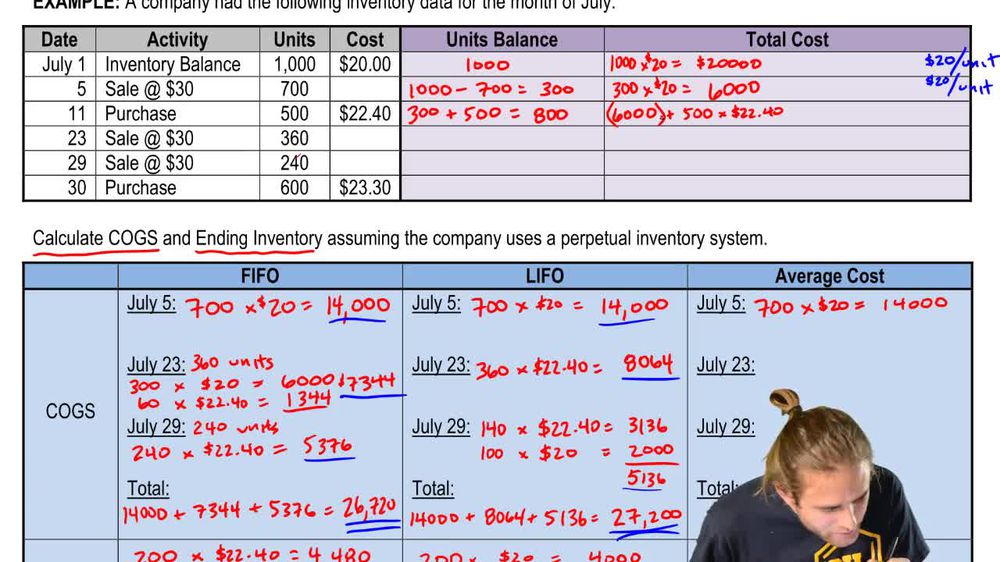
 10:12
10:12