Skip to main content
Financial Accounting
My Course
Learn
Exam Prep
AI Tutor
Study Guides
Flashcards
Explore
Try the app
My Course
Learn
Exam Prep
AI Tutor
Study Guides
Flashcards
Explore
Try the app
Back
Preferred Stock definitions
You can tap to flip the card.
Preferred Stock
You can tap to flip the card.
👆
Preferred Stock
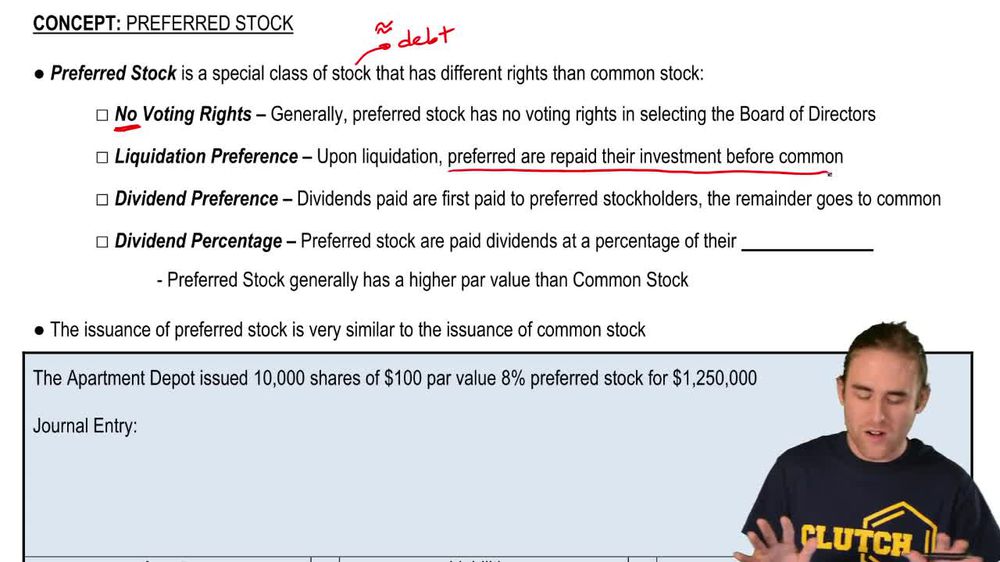
A class of equity with fixed dividend percentage, higher par value, no voting rights, and priority in dividends and liquidation over common stock.
Track progress
Control buttons has been changed to "navigation" mode.
1/15
Related flashcards
Related practice
Recommended videos
Preferred Stock quiz #1
Preferred Stock
23 Terms
Preferred Stock
12. Stockholders' Equity
10 problems
Topic
Treasury Stock
12. Stockholders' Equity
10 problems
Topic
12. Stockholders' Equity
12 topics
15 problems
Chapter
Guided course
04:44
Preferred Dividends
1060
views
30
rank
Guided course
06:28
Issuing Preferred Stock
1140
views
21
rank
Terms in this set (15)
Hide definitions
Preferred Stock
A class of equity with fixed dividend percentage, higher par value, no voting rights, and priority in dividends and liquidation over common stock.
Par Value
A nominal value assigned to a share, often higher for preferred stock, used to calculate dividends and record equity.
Dividend Preference
The right to receive dividends before common stockholders, typically at a fixed rate based on par value.
Liquidation Preference
Priority status in receiving repayment of investment before common stockholders if a company is liquidated.
Voting Rights
The ability to participate in corporate decisions, typically not granted to holders of preferred stock.
Common Stock
A class of equity with lower par value, voting rights, and residual claim on dividends and assets after preferred stockholders.
Dividend Percentage
A fixed rate, usually stated as a percent of par value, used to determine preferred stockholders' dividend amounts.
Additional Paid-In Capital (APIC)
Equity account reflecting the amount received from stock issuance above par value, tracked separately for preferred stock.
Equity
Ownership interest in a company, including both common and preferred stock, representing claims on assets after liabilities.
Dividend Distribution
The allocation of declared dividends, with preferred stockholders receiving their fixed amount before any is given to common stockholders.
Issuance Entry
Accounting record of stock issuance, involving cash received, credit to stock account for par value, and credit to APIC for excess.
Retained Earnings
Accumulated profits not distributed as dividends, available to common stockholders after preferred claims are satisfied.
Shareholder
An individual or entity owning shares in a company, classified as either preferred or common based on stock type.
Dividend Per Share
The amount of dividend allocated to each share, calculated by dividing total dividends by the number of shares outstanding.
Bankruptcy
A financial state triggering company liquidation, where preferred stockholders are prioritized for repayment over common stockholders.
 BackBack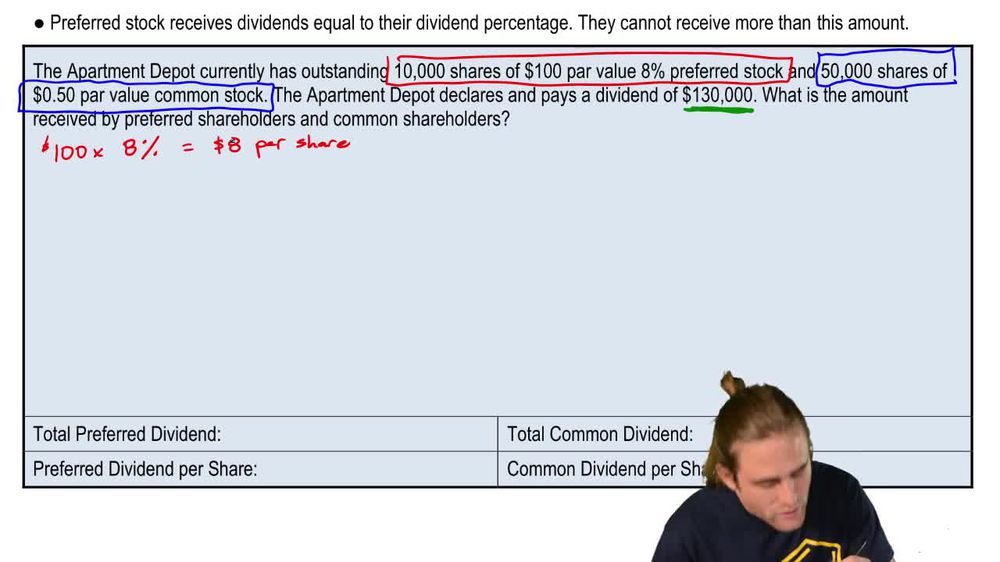
 04:44
04:44