Skip to main content
Financial Accounting
My Course
Learn
Exam Prep
AI Tutor
Study Guides
Flashcards
Explore
Try the app
My Course
Learn
Exam Prep
AI Tutor
Study Guides
Flashcards
Explore
Try the app
Back
Ratios: Debt to Equity Ratio definitions
You can tap to flip the card.
Debt to Equity Ratio
You can tap to flip the card.
👆
Debt to Equity Ratio
A measure comparing total liabilities to total equity, indicating how a company's assets are financed between debt and shareholder investment.
Track progress
Control buttons has been changed to "navigation" mode.
1/15
Related flashcards
Related practice
Recommended videos
Ratios: Debt to Equity Ratio quiz #1
Ratios: Debt to Equity Ratio
14 Terms
Ratios: Debt to Equity Ratio
14. Financial Statement Analysis
10 problems
Topic
Ratios: Payout Ratio
14. Financial Statement Analysis
10 problems
Topic
14. Financial Statement Analysis
15 topics
15 problems
Chapter
Guided course
02:44
Ratios: Debt to Equity Ratio
965
views
10
rank
Terms in this set (15)
Hide definitions
Debt to Equity Ratio
A measure comparing total liabilities to total equity, indicating how a company's assets are financed between debt and shareholder investment.
Leverage Ratio
A financial metric assessing the extent to which a company uses borrowed funds relative to other sources of capital.
Liabilities
Obligations or debts owed to external parties, representing claims against a company's assets.
Equity
Ownership interest held by shareholders, representing residual value after liabilities are subtracted from assets.
Assets
Resources owned by a company, including cash, inventory, property, and equipment, used to generate value.
Financial Leverage
The use of borrowed funds to increase the potential return on equity, often increasing both risk and reward.
Interest Expense
Mandatory payments made to lenders for the use of borrowed funds, regardless of company profitability.
Dividends
Distributions of profits to shareholders, which can be deferred or omitted at management's discretion.
Risk
The potential for financial loss or instability, often heightened by increased reliance on debt financing.
Debt Ratio
A metric comparing total liabilities to total assets, distinct from the debt to equity ratio.
Shareholders
Individuals or entities owning equity in a company, entitled to residual claims and potential dividends.
Numerator
The top part of a ratio, representing the value being compared, such as total liabilities in the debt to equity ratio.
Denominator
The bottom part of a ratio, serving as the basis for comparison, such as total equity in the debt to equity ratio.
Fixed Expense
A cost that must be paid regularly, such as interest on debt, regardless of business performance.
Loan
Borrowed funds that must be repaid with interest, contributing to a company's liabilities and financial leverage.
 BackBack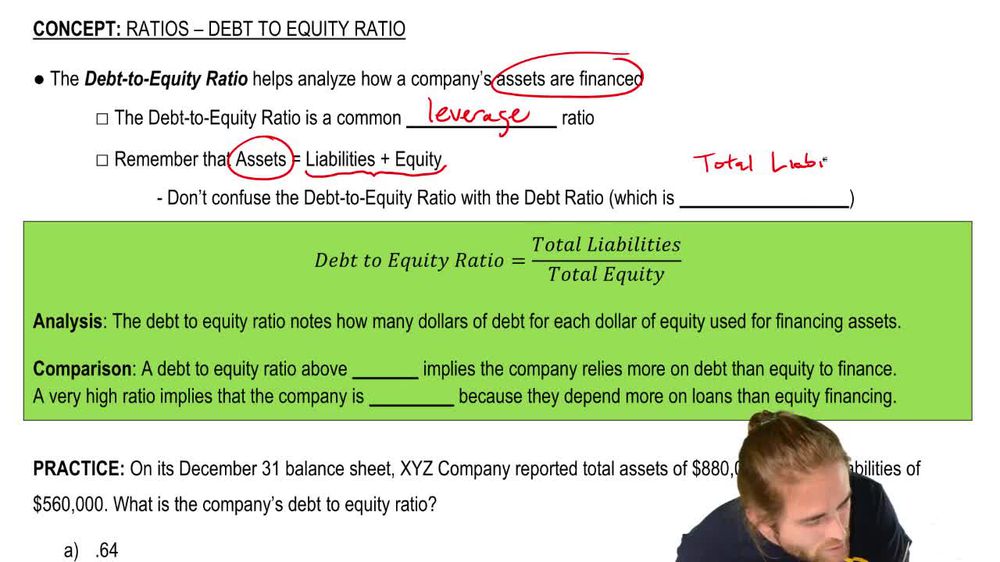
 02:44
02:44