Skip to main content
Financial Accounting
My Course
Learn
Exam Prep
AI Tutor
Study Guides
Flashcards
Explore
Try the app
My Course
Learn
Exam Prep
AI Tutor
Study Guides
Flashcards
Explore
Try the app
Back
Ratios: Quick (Acid Test) Ratio definitions
You can tap to flip the card.
Quick Ratio
You can tap to flip the card.
👆
Quick Ratio
A liquidity measure showing how well highly liquid assets can cover current liabilities without relying on inventory or prepaid expenses.
Track progress
Control buttons has been changed to "navigation" mode.
1/15
Related flashcards
Related practice
Recommended videos
Ratios: Quick (Acid Test) Ratio quiz #1
Ratios: Quick (Acid Test) Ratio
13 Terms
Ratios: Quick (Acid Test) Ratio
14. Financial Statement Analysis
10 problems
Topic
Ratios: Gross Profit Rate
14. Financial Statement Analysis
10 problems
Topic
14. Financial Statement Analysis
15 topics
15 problems
Chapter
Guided course
07:32
Ratios: Quick (Acid Test) Ratio
1605
views
31
rank
Terms in this set (15)
Hide definitions
Quick Ratio
A liquidity measure showing how well highly liquid assets can cover current liabilities without relying on inventory or prepaid expenses.
Acid Test Ratio
Another name for a strict liquidity ratio that excludes less liquid current assets like inventory and prepaid expenses.
Liquidity Ratio
A financial metric assessing a company's ability to meet short-term obligations using assets easily converted to cash.
Current Assets
Resources expected to be converted into cash or used up within one year, including cash, receivables, inventory, and prepaid expenses.
Current Liabilities
Obligations due within one year, such as accounts payable and short-term debt, used as the denominator in liquidity ratios.
Cash
The most liquid asset, immediately available for settling obligations and always included in the numerator of the quick ratio.
Short-Term Investments
Marketable securities or assets that can be quickly sold for cash, often included in the quick ratio calculation.
Net Accounts Receivable
Amounts owed by customers expected to be collected soon, considered highly liquid for quick ratio purposes.
Inventory
Goods held for sale, excluded from the quick ratio due to lower liquidity compared to other current assets.
Prepaid Expenses
Payments made in advance for goods or services, excluded from the quick ratio as they cannot be quickly converted to cash.
Current Ratio
A broader liquidity measure including all current assets, less strict than the quick ratio in assessing short-term solvency.
Short-Term Debt
A component of current liabilities, representing borrowings due within a year, included in the denominator of the quick ratio.
Highly Liquid Assets
Resources that can be rapidly converted to cash with minimal loss in value, central to the quick ratio's numerator.
Threshold
A benchmark value, such as a quick ratio of 1, used to assess whether a company can safely cover its current liabilities.
Red Flag
A warning indicator, such as a quick ratio below 1, signaling potential liquidity problems for a company.
 BackBack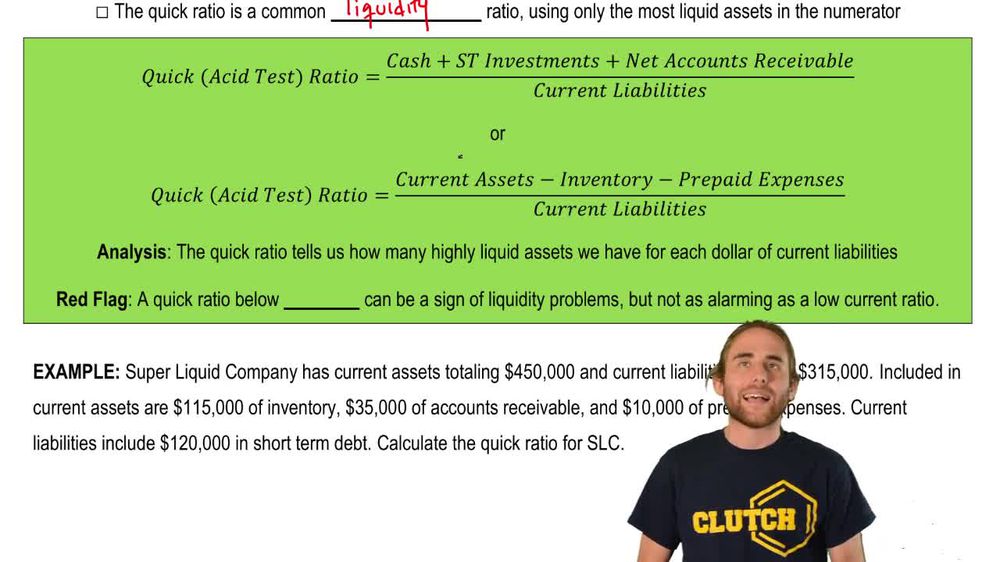
 07:32
07:32