Skip to main content
Financial Accounting
My Course
Learn
Exam Prep
AI Tutor
Study Guides
Flashcards
Explore
Try the app
My Course
Learn
Exam Prep
AI Tutor
Study Guides
Flashcards
Explore
Try the app
Back
Ratios: Return on Assets (ROA) definitions
You can tap to flip the card.
Return on Assets
You can tap to flip the card.
👆
Return on Assets
A financial metric indicating how much net income is generated for each dollar invested in assets, reflecting both profitability and efficiency.
Track progress
Control buttons has been changed to "navigation" mode.
1/15
Related flashcards
Related practice
Recommended videos
Ratios: Return on Assets (ROA) quiz #1
Ratios: Return on Assets (ROA)
28 Terms
Ratios: Return on Assets (ROA)
14. Financial Statement Analysis
10 problems
Topic
Ratios: Total Asset Turnover
14. Financial Statement Analysis
10 problems
Topic
14. Financial Statement Analysis
15 topics
15 problems
Chapter
Guided course
03:42
Ratios: Return on Assets (ROA)
1246
views
17
rank
1
comments
Terms in this set (15)
Hide definitions
Return on Assets
A financial metric indicating how much net income is generated for each dollar invested in assets, reflecting both profitability and efficiency.
ROA
A common abbreviation for a ratio that measures how effectively a company uses its assets to produce net income.
Net Income
The profit remaining after all expenses, taxes, and costs are subtracted from total revenue, used as the numerator in ROA.
Average Total Assets
The mean value of a company's assets over a period, calculated by adding beginning and ending balances and dividing by two.
Profitability Ratio
A category of financial metrics that assess a company's ability to generate earnings relative to its resources.
Efficiency Ratio
A measure that evaluates how well a company utilizes its assets to produce income.
Benchmarking
The process of comparing a company's financial ratios, such as ROA, to competitors or industry averages to assess performance.
Net Loss
A situation where total expenses exceed total revenues, resulting in a negative value for net income.
Denominator
The bottom part of a ratio formula, representing the total assets in the ROA calculation.
Numerator
The top part of a ratio formula, representing net income in the ROA calculation.
Percentage
A way of expressing a ratio as a fraction of 100, commonly used to present ROA for easier interpretation.
Industry Average
A standard value derived from similar companies, used as a reference point for evaluating a company's financial ratios.
Assets
Resources owned by a company, such as cash, equipment, or property, used to generate income.
Balance Sheet
A financial statement that reports a company's assets, liabilities, and equity at a specific point in time.
Red Flag
An indicator, such as a negative ROA, that signals potential financial problems or inefficiency within a company.
 BackBack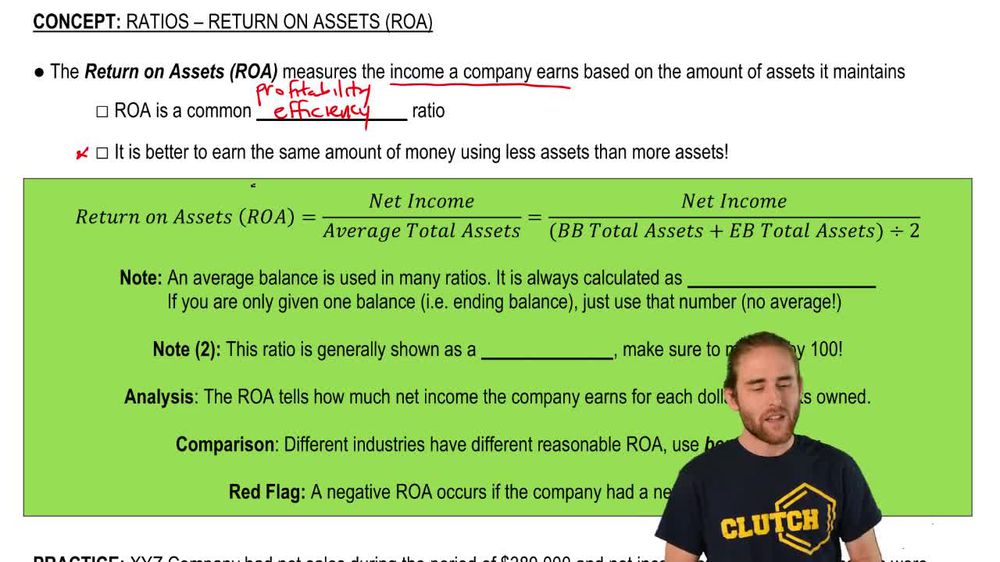
 03:42
03:42