Skip to main content
Financial Accounting
My Course
Learn
Exam Prep
AI Tutor
Study Guides
Flashcards
Explore
Try the app
My Course
Learn
Exam Prep
AI Tutor
Study Guides
Flashcards
Explore
Try the app
Back
Ratios: Times Interest Earned (TIE) definitions
You can tap to flip the card.
Times Interest Earned Ratio
You can tap to flip the card.
👆
Times Interest Earned Ratio
A solvency measure showing how many times operating income can cover interest expense, indicating a firm's ability to meet debt obligations.
Track progress
Control buttons has been changed to "navigation" mode.
1/15
Related flashcards
Related practice
Recommended videos
Ratios: Times Interest Earned (TIE) quiz #1
Ratios: Times Interest Earned (TIE)
16 Terms
Ratios: Times Interest Earned (TIE)
14. Financial Statement Analysis
10 problems
Topic
Ratios: Debt to Asset Ratio
14. Financial Statement Analysis
10 problems
Topic
14. Financial Statement Analysis
15 topics
15 problems
Chapter
Guided course
03:44
Ratios: Times Interest Earned (TIE)
923
views
9
rank
Terms in this set (15)
Hide definitions
Times Interest Earned Ratio
A solvency measure showing how many times operating income can cover interest expense, indicating a firm's ability to meet debt obligations.
Solvency Ratio
A financial metric assessing a company's capacity to meet long-term debts and interest obligations using its income.
Operating Income
Earnings from core business activities after deducting operating expenses, but before interest and taxes.
Interest Expense
The cost incurred by a company for borrowed funds, typically paid periodically to lenders.
Net Income
The bottom-line profit remaining after all expenses, including interest and taxes, are subtracted from total revenue.
Income Tax Expense
The amount a company owes in taxes based on its taxable income, usually listed as a non-operating expense.
Non-Operating Expense
Costs not related to core business operations, such as interest and income tax expenses.
Financial Statement
A formal record summarizing a company's financial activities, used by banks to monitor loan agreements.
Loan Default
A situation where a borrower fails to meet the terms of a loan agreement, often triggered by not maintaining required ratios.
Loan Agreement
A contract outlining the terms under which money is borrowed, often specifying required financial ratios.
Core Business Activities
Primary operations generating a company's main revenue, excluding non-operating items like interest and taxes.
Contract Requirement
A stipulated condition in a legal agreement, such as maintaining a minimum financial ratio.
Financial Distress
A state where a company struggles to meet financial obligations, often signaled by a low solvency ratio.
Solvency
The ability of a company to meet its long-term financial commitments and avoid default.
Denominator
The bottom part of a fraction in a ratio calculation, such as interest expense in the TIE formula.
 BackBack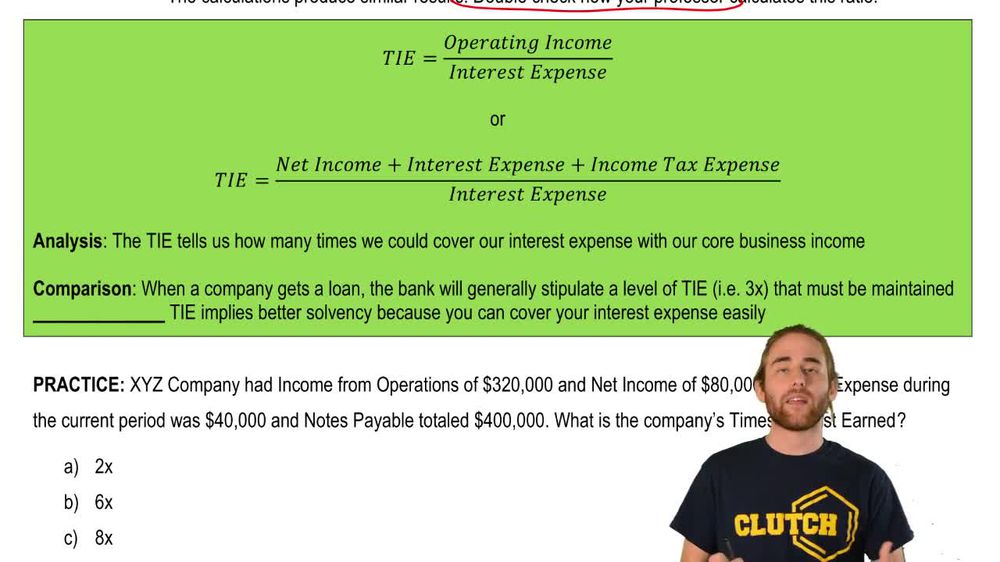
 03:44
03:44