Skip to main content
Financial Accounting
My Course
Learn
Exam Prep
AI Tutor
Study Guides
Flashcards
Explore
Try the app
My Course
Learn
Exam Prep
AI Tutor
Study Guides
Flashcards
Explore
Try the app
Back
Specific Identification definitions
You can tap to flip the card.
Specific Identification Method
You can tap to flip the card.
👆
Specific Identification Method
Inventory valuation approach used when each item is unique or easily tracked, allowing precise matching of cost to each unit sold.
Track progress
Control buttons has been changed to "navigation" mode.
1/15
Related flashcards
Related practice
Recommended videos
Specific Identification quiz #1
Specific Identification
10 Terms
Specific Identification
5. Inventory
10 problems
Topic
Periodic Inventory - FIFO, LIFO, and Average Cost
5. Inventory
10 problems
Topic
5. Inventory - Part 1 of 2
6 topics
13 problems
Chapter
5. Inventory - Part 2 of 2
1 topic
3 problems
Chapter
Guided course
04:47
Specific Identification of Inventory
1505
views
26
rank
Terms in this set (15)
Hide definitions
Specific Identification Method
Inventory valuation approach used when each item is unique or easily tracked, allowing precise matching of cost to each unit sold.
Inventory Valuation
Process of assigning monetary value to goods held for sale, crucial for financial reporting and profit calculation.
Unique Inventory
Goods that are distinguishable from one another, often due to customization or high value, enabling individual tracking.
Cost of Goods Sold
Expense representing the original purchase price of inventory items that have been sold during a period.
Ending Inventory
Total value of unsold goods remaining at the end of an accounting period, based on their original purchase cost.
Journal Entry
Formal accounting record documenting the financial impact of a transaction, including debits and credits.
Revenue
Total income generated from selling goods or services before deducting any costs or expenses.
Accounts Receivable
Asset representing money owed by customers for goods or services delivered but not yet paid for.
Gross Profit
Difference between total sales revenue and the cost of goods sold, indicating profitability from core operations.
Cash
Immediate payment received in currency or its equivalents, increasing a company's liquid assets.
Asset
Resource owned by a business, such as cash or receivables, expected to provide future economic benefit.
Inventory Balance
Current total value of goods available for sale, updated after each transaction involving inventory.
Credit
Accounting entry that increases liabilities or equity, or decreases assets, often used to record revenue.
Debit
Accounting entry that increases assets or expenses, or decreases liabilities or equity, reflecting value received.
High-Value Goods
Items with significant monetary worth, often tracked individually due to their impact on financial statements.
 BackBack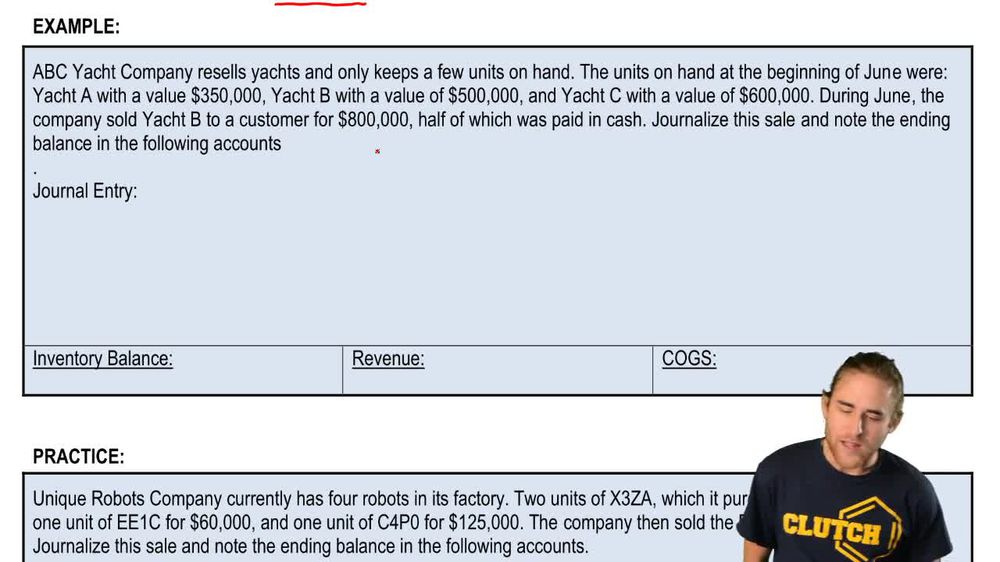
 04:47
04:47