Skip to main content
Financial Accounting
My Course
Learn
Exam Prep
AI Tutor
Study Guides
Flashcards
Explore
Try the app
My Course
Learn
Exam Prep
AI Tutor
Study Guides
Flashcards
Explore
Try the app
Back
Stock Splits definitions
You can tap to flip the card.
Stock Split
You can tap to flip the card.
👆
Stock Split
Corporate action dividing existing shares into multiple new shares, increasing share count but leaving total equity unchanged.
Track progress
Control buttons has been changed to "navigation" mode.
1/13
Related flashcards
Related practice
Recommended videos
Stock Splits quiz #1
Stock Splits
10 Terms
Stock Splits
12. Stockholders' Equity
9 problems
Topic
Stock Dividends
12. Stockholders' Equity
10 problems
Topic
12. Stockholders' Equity
12 topics
15 problems
Chapter
Guided course
06:25
Stock Splits
829
views
14
rank
Guided course
02:50
Stock Splits
624
views
21
rank
Terms in this set (13)
Hide definitions
Stock Split
Corporate action dividing existing shares into multiple new shares, increasing share count but leaving total equity unchanged.
Par Value
Nominal value assigned to a share, which decreases proportionally after a stock split.
Market Price
Current trading value of a share, which is reduced in proportion to the split ratio after a stock split.
Stockholders' Equity
Total ownership value in a company, unaffected by stock splits despite changes in share count and par value.
Split Ratio
Numerical expression, such as 2 for 1, indicating how many new shares replace each old share in a stock split.
Shares Outstanding
Total number of a company's shares held by investors, which increases according to the split ratio after a stock split.
Memo Entry
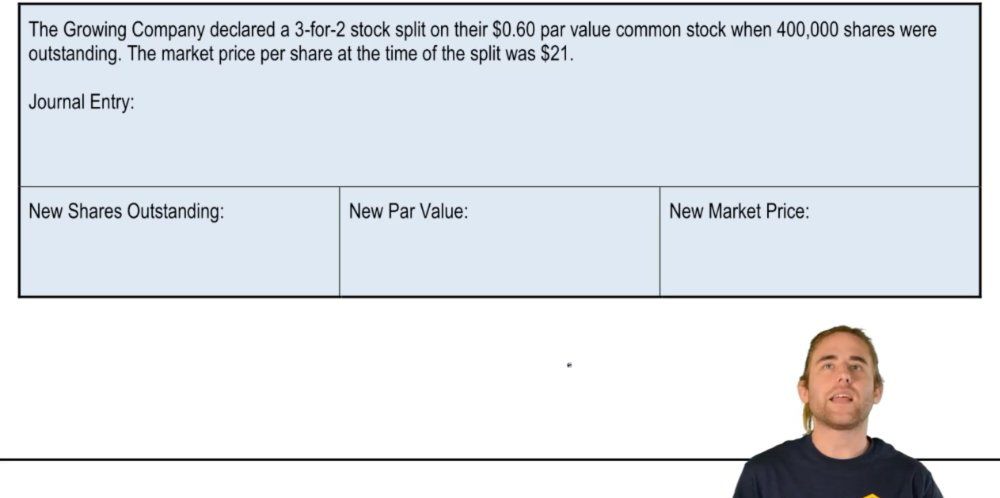
Internal record noting changes in share structure after a stock split, since no formal journal entry is required.
Common Stock
Type of equity security affected by stock splits, resulting in more shares with lower par value per share.
Paid-in Capital
Amount invested by shareholders, which remains unchanged during a stock split.
Retained Earnings
Accumulated profits not distributed as dividends, unaffected by stock splits.
2 for 1 Stock Split
Most common split, doubling the number of shares while halving both par value and market price per share.
Journal Entry
Formal accounting record not required for stock splits, as no financial accounts are directly affected.
Pie Analogy
Visual comparison illustrating that a stock split divides ownership into more pieces without changing the total value.
 BackBack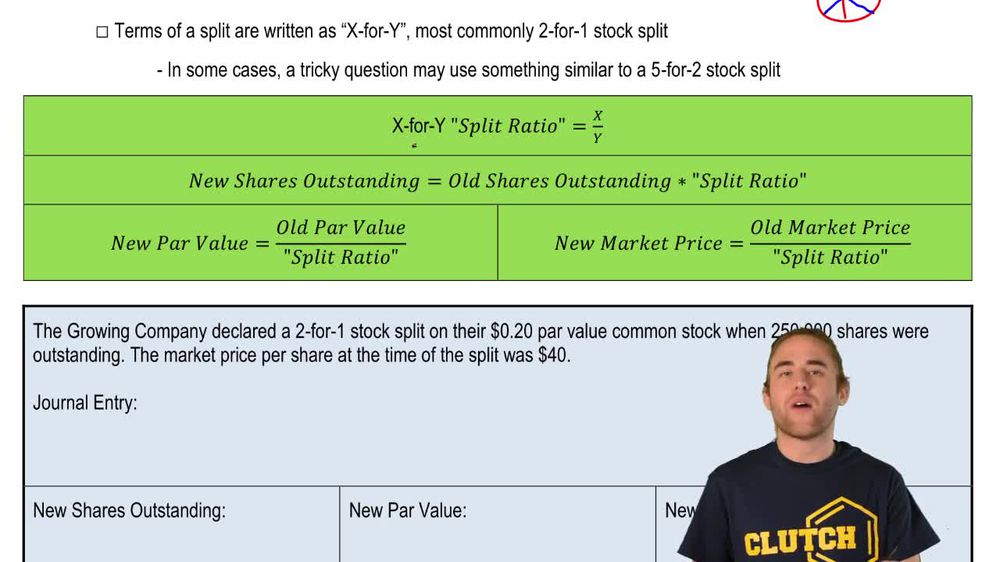
 06:25
06:25