Skip to main content
Financial Accounting
My Course
Learn
Exam Prep
AI Tutor
Study Guides
Flashcards
Explore
Try the app
My Course
Learn
Exam Prep
AI Tutor
Study Guides
Flashcards
Explore
Try the app
Back
Straight Line Amortization of Bond Premium or Discount definitions
You can tap to flip the card.
Face Value
You can tap to flip the card.
👆
Face Value
Principal amount of a bond stated on its certificate, representing the sum repaid to bondholders at maturity.
Track progress
Control buttons has been changed to "navigation" mode.
1/15
Related flashcards
Related practice
Recommended videos
Straight Line Amortization of Bond Premium or Discount quiz #1
Straight Line Amortization of Bond Premium or Discount
10 Terms
Straight Line Amortization of Bond Premium or Discount
11. Long Term Liabilities
10 problems
Topic
Effective Interest Amortization of Bond Premium or Discount
11. Long Term Liabilities
7 problems
Topic
11. Long Term Liabilities
8 topics
13 problems
Chapter
Guided course
04:07
Straight Line Amortization:Bond Premium
1198
views
15
rank
Guided course
02:34
Straight Line Amortization:Bond Discount
573
views
9
rank
Guided course
03:27
Straight Line Amortization:Bond Discount
746
views
9
rank
Terms in this set (15)
Hide definitions
Face Value
Principal amount of a bond stated on its certificate, representing the sum repaid to bondholders at maturity.
Stated Rate
Interest percentage printed on a bond, used to calculate periodic interest payments to bondholders.
Market Rate
Prevailing interest percentage in the market for similar bonds, influencing bond pricing at issuance.
Premium
Excess amount received over a bond’s face value when issued, occurring when the stated rate exceeds the market rate.
Discount
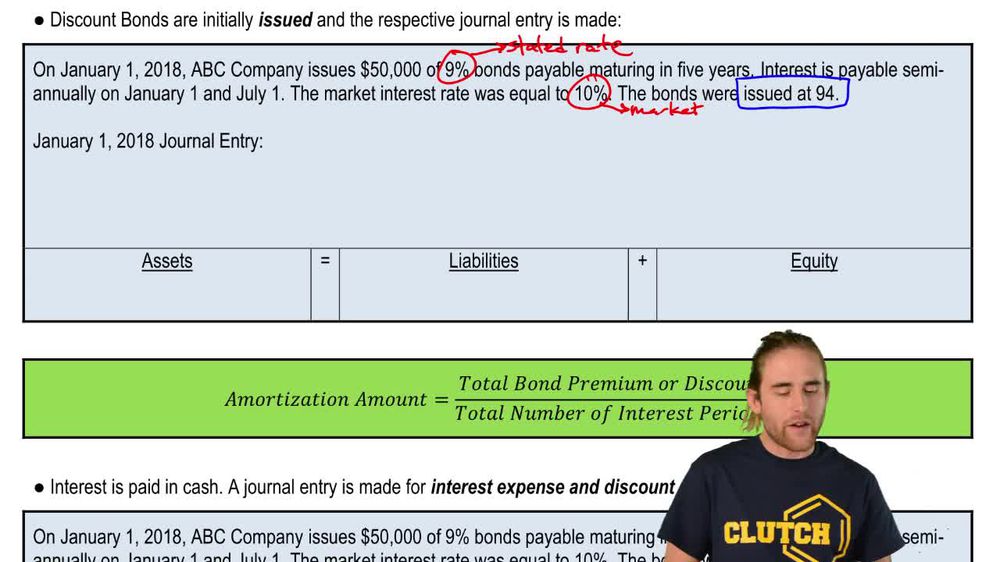
Shortfall between cash received and a bond’s face value at issuance, resulting when the stated rate is below the market rate.
Straight Line Amortization
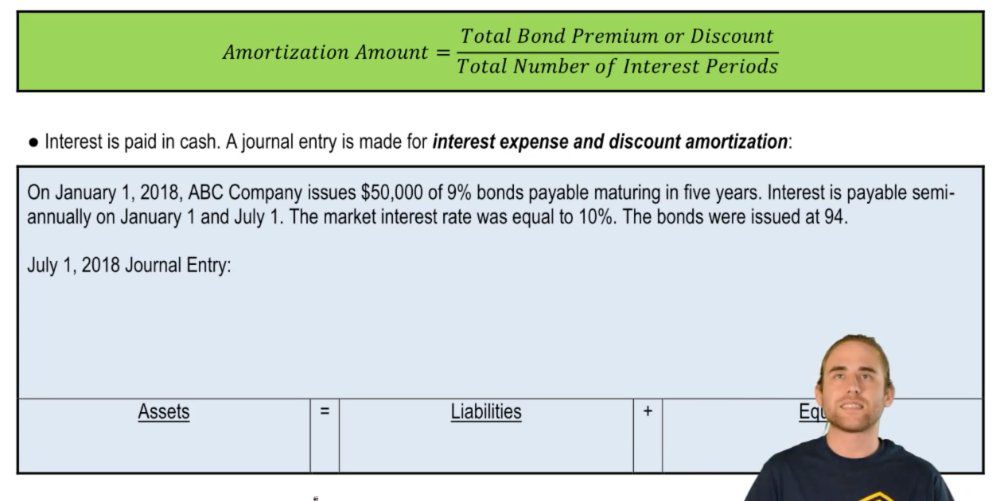
Method allocating equal portions of bond premium or discount to each interest period over the bond’s life.
Interest Expense
Total cost recognized each period for borrowing, combining cash interest and amortized premium or discount.
Bonds Payable
Long-term liability account representing the total principal owed to bondholders at maturity.
Premium on Bonds Payable
Liability account reflecting the amount received above face value, reduced over time through amortization.
Discount on Bonds Payable
Contra-liability account showing the amount below face value, systematically reduced as interest expense increases.
Carrying Value
Net amount of bonds payable after adjusting for unamortized premium or discount, representing the bond’s book value.
Semiannual Interest Period
Six-month interval used for calculating and paying interest on bonds, doubling the number of periods per year.
Issuance Entry
Initial journal record capturing cash received, liability created, and any premium or discount at bond issuance.
Interest Payment
Periodic cash outflow to bondholders, calculated using the face value and stated rate, often adjusted for payment frequency.
Plug
Balancing figure in a journal entry, ensuring debits and credits are equal, often used for interest expense in amortization.
 BackBack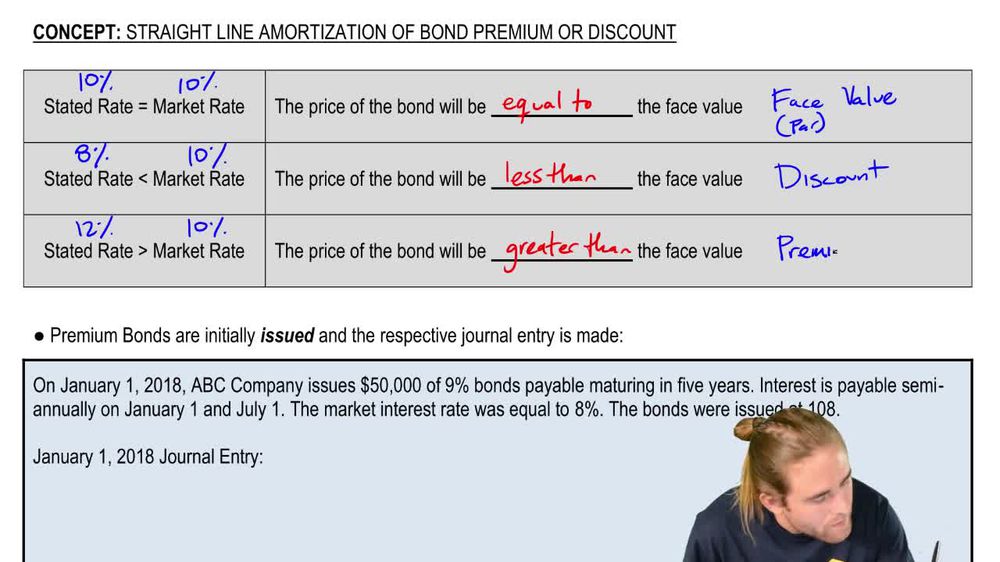
 04:07
04:07