Skip to main content
Financial Accounting
My Course
Learn
Exam Prep
AI Tutor
Study Guides
Flashcards
Explore
Try the app
My Course
Learn
Exam Prep
AI Tutor
Study Guides
Flashcards
Explore
Try the app
Back
Time Value of Money Equations definitions
You can tap to flip the card.
Time Value of Money
You can tap to flip the card.
👆
Time Value of Money
Financial principle stating that money available now is more valuable than the same amount in the future due to its earning potential.
Track progress
Control buttons has been changed to "navigation" mode.
1/15
Related flashcards
Related practice
Recommended videos
Time Value of Money Equations quiz #1
Time Value of Money Equations
40 Terms
Time Value of Money Equations quiz #2
Time Value of Money Equations
40 Terms
Time Value of Money Equations quiz #3
Time Value of Money Equations
40 Terms
Time Value of Money Equations
10. Time Value of Money
10 problems
Topic
Using Time Value of Money Tables
10. Time Value of Money
10 problems
Topic
10. Time Value of Money
2 topics
15 problems
Chapter
Guided course
05:53
Annuity
826
views
16
rank
Guided course
05:55
Time Value of Money and Using Timelines
1768
views
38
rank
1
comments
Guided course
04:37
Time Value of Money Equation:Future Value
1124
views
20
rank
Terms in this set (15)
Hide definitions
Time Value of Money
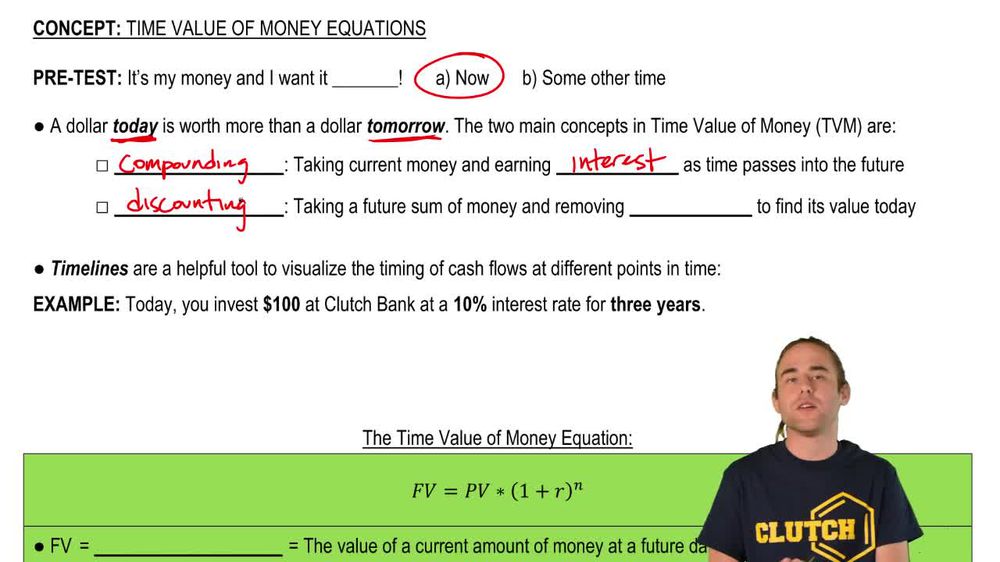
Financial principle stating that money available now is more valuable than the same amount in the future due to its earning potential.
Compounding
Process where interest is earned on both the initial principal and previously accumulated interest, increasing value over time.
Discounting
Method of determining the present worth of a future sum by removing the interest that would accrue over time.
Future Value
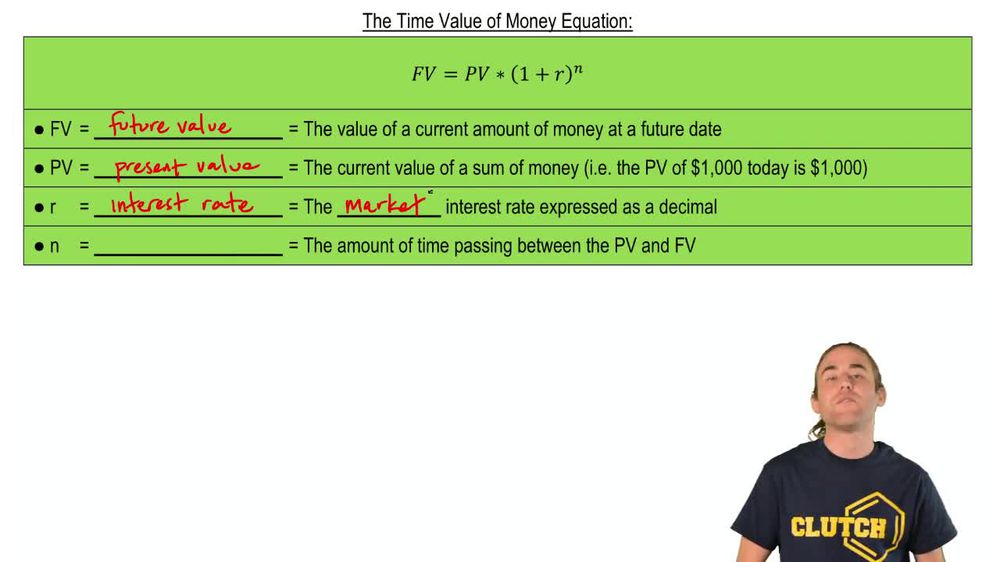
Amount an investment will grow to at a specified date in the future, factoring in interest earned over time.
Present Value
Current worth of a future sum of money, calculated by removing the interest that would be earned over time.
Interest Rate
Percentage used to calculate how much interest is earned or paid over a period, often expressed as a decimal in formulas.
Number of Periods
Total count of time intervals, usually years, over which money is invested or borrowed in time value calculations.
Market Interest Rate
Prevailing rate in the financial market used for discounting or compounding in time value of money equations.
Lump Sum
Single payment or receipt of money, as opposed to a series of payments, often used in basic time value calculations.
Annuity
Series of equal payments made at regular, equal intervals, such as annually or semi-annually.
Ordinary Annuity
Type of annuity where equal payments begin one period after the present, typically starting one year from now.
Timeline
Visual representation used to map out cash flows, interest rates, and periods for time value of money problems.
Cash Flow
Movement of money into or out of an account, often represented on a timeline to track payments or receipts.
Present Value Table
Reference chart providing factors to simplify calculation of present values for annuities or lump sums.
Payment
Fixed amount in each period of an annuity, denoted as PMT in time value of money equations.
 BackBack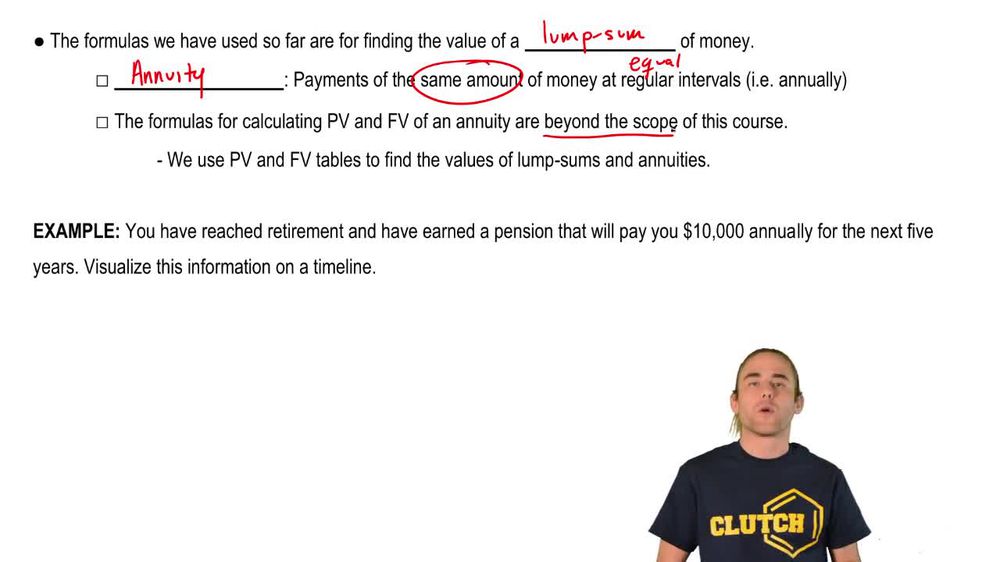
 05:53
05:53