Skip to main content
Financial Accounting
My Course
Learn
Exam Prep
AI Tutor
Study Guides
Flashcards
Explore
Try the app
My Course
Learn
Exam Prep
AI Tutor
Study Guides
Flashcards
Explore
Try the app
Back
Treasury Stock definitions
You can tap to flip the card.
Treasury Stock
You can tap to flip the card.
👆
Treasury Stock
Shares previously issued and later repurchased by a company, held as a contra equity account with a debit balance, not entitled to dividends.
Track progress
Control buttons has been changed to "navigation" mode.
1/13
Related flashcards
Related practice
Recommended videos
Treasury Stock quiz #1
Treasury Stock
14 Terms
Treasury Stock
12. Stockholders' Equity
10 problems
Topic
Dividends and Dividend Preferences
12. Stockholders' Equity
10 problems
Topic
12. Stockholders' Equity
12 topics
15 problems
Chapter
Guided course
02:53
Treasury Stock
1051
views
17
rank
Guided course
04:43
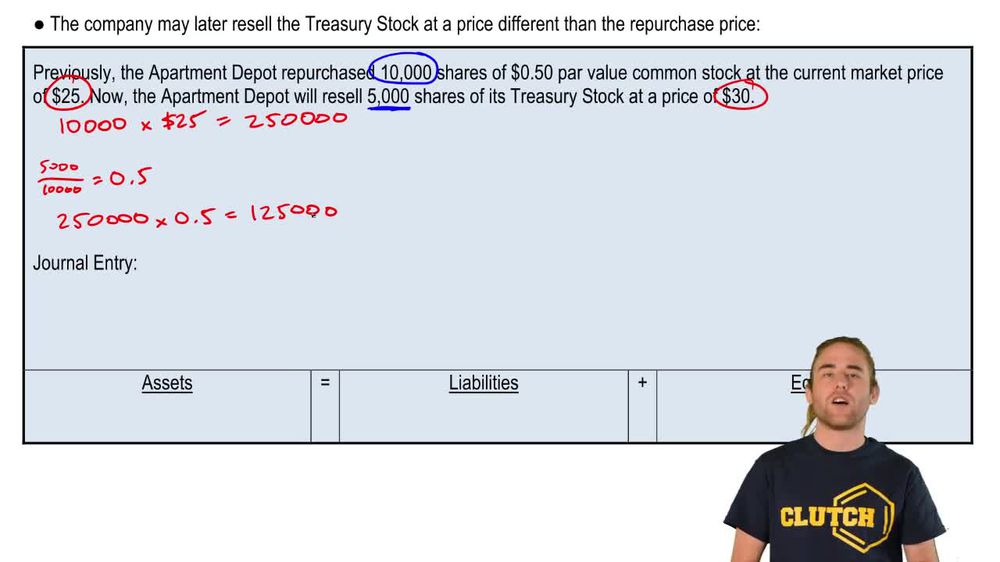
Selling Treasury Stock from the Treasury
861
views
24
rank
Guided course
02:04
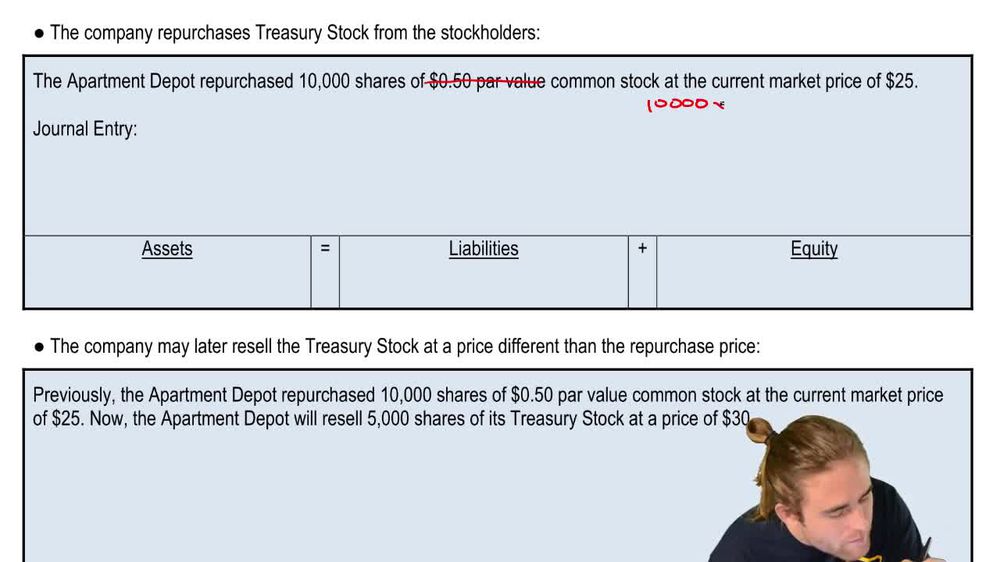
Repurchasing Stock into Treasury
929
views
20
rank
Terms in this set (13)
Hide definitions
Treasury Stock
Shares previously issued and later repurchased by a company, held as a contra equity account with a debit balance, not entitled to dividends.
Contra Equity Account
Equity classification that reduces total equity, typically carrying a debit balance, such as the account used for repurchased shares.
Debit Balance
Accounting state where the left side of an account exceeds the right, characteristic of accounts that reduce equity like repurchased shares.
Outstanding Shares
Portion of issued shares still held by external investors, eligible for dividends and not repurchased by the company.
Issued Shares
Total number of shares a company has distributed to investors, including those later repurchased as treasury stock.
Cost Method
Accounting approach for repurchased shares focusing on the amount paid to reacquire stock, ignoring par value in journal entries.
Par Value
Nominal value assigned to shares, not relevant when recording repurchased shares under the cost method.
Market Price
Current trading value of a company's shares, used as the basis for repurchase transactions involving treasury stock.
Dividends
Distributions of profits to shareholders, not paid on shares held as treasury stock.
Additional Paid-In Capital (APIC)
Equity account used to record differences between cash received and original cost when reselling repurchased shares.
Journal Entry
Formal accounting record of a transaction, such as repurchasing or reselling shares, affecting cash, equity, and related accounts.
Equity
Residual interest in a company's assets after liabilities, reduced by treasury stock transactions and increased when such shares are resold.
Cash
Asset account affected by treasury stock transactions, decreased when shares are repurchased and increased when resold.
 BackBack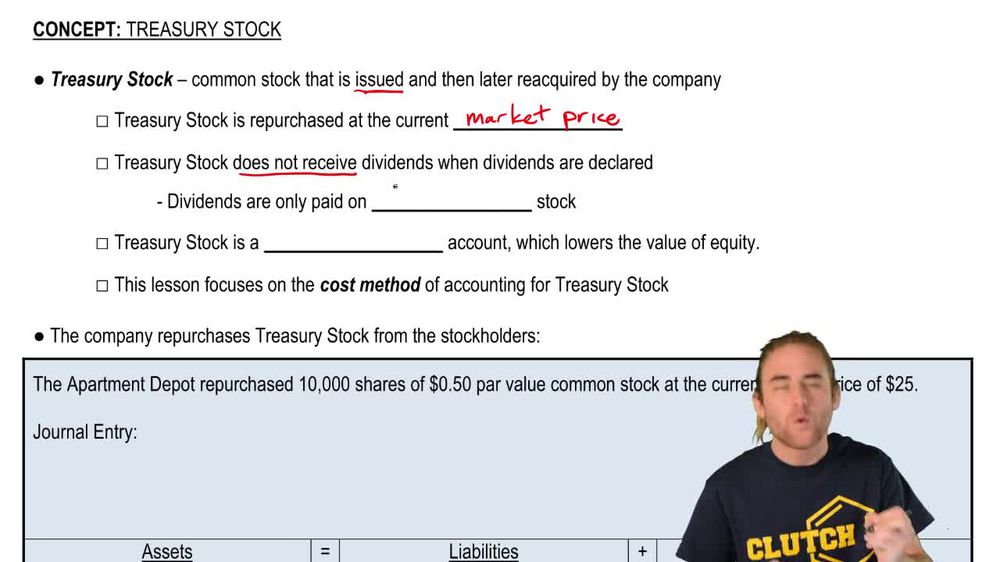
 02:53
02:53