
Ch.13 - Solutions
Tro - Chemistry: A Molecular Approach 4th Edition
Tro4th EditionChemistry: A Molecular ApproachISBN: 9780134112831Not the one you use?Change textbook
Chapter 13, Problem 113

A solution is prepared from 4.5701 g of magnesium chloride and 43.238 g of water. The vapor pressure of water above this solution is 0.3624 atm at 348.0 K. The vapor pressure of pure water at this temperature is 0.3804 atm. What is the value of the van’t Hoff factor (i) for magnesium chloride in this solution?

Verified step by step guidance
1
Calculate the molality of the solution by first determining the moles of magnesium chloride (MgCl_2) using its molar mass.
Determine the molality (m) of the solution using the formula: \( m = \frac{\text{moles of solute}}{\text{kilograms of solvent}} \).
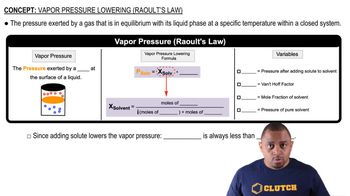
Use Raoult's Law to find the expected vapor pressure of the solution: \( P_{solution} = X_{solvent} \times P^0_{solvent} \), where \( X_{solvent} \) is the mole fraction of the solvent.
Calculate the mole fraction of the solvent (water) using the formula: \( X_{solvent} = \frac{\text{moles of solvent}}{\text{moles of solvent} + i \times \text{moles of solute}} \).
Rearrange the equation from Raoult's Law to solve for the van’t Hoff factor \( i \) using the given vapor pressures and the calculated mole fraction.

Key Concepts

Here are the essential concepts you must grasp in order to answer the question correctly.

Colligative Properties

Colligative properties are physical properties of solutions that depend on the number of solute particles in a given amount of solvent, rather than the identity of the solute. These properties include vapor pressure lowering, boiling point elevation, freezing point depression, and osmotic pressure. In this question, the vapor pressure lowering of water due to the presence of magnesium chloride is a key aspect to determine the van’t Hoff factor.

Vapor Pressure

Vapor pressure is the pressure exerted by a vapor in equilibrium with its liquid or solid phase at a given temperature. The presence of a solute, such as magnesium chloride, reduces the vapor pressure of the solvent (water) compared to its pure state. This reduction can be quantified using Raoult's Law, which relates the vapor pressure of the solution to the mole fraction of the solvent and the vapor pressure of the pure solvent.
Recommended video:
Guided course
02:40
Raoult's Law and Vapor Pressure

van’t Hoff Factor (i)

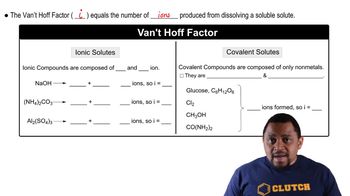
The van’t Hoff factor (i) is a dimensionless quantity that represents the number of particles into which a solute dissociates in solution. For ionic compounds like magnesium chloride, which dissociates into multiple ions (Mg²⁺ and 2Cl⁻), the van’t Hoff factor is greater than one. Calculating i is essential for understanding how the solute affects colligative properties, such as vapor pressure lowering in this scenario.
Recommended video:
Guided course
02:50
Van't Hoff Factor