Skip to main content
GOB Chemistry
My Course
Learn
Exam Prep
AI Tutor
Study Guides
Textbook Solutions
Flashcards
Explore
Try the app
My Course
Learn
Exam Prep
AI Tutor
Study Guides
Textbook Solutions
Flashcards
Explore
Try the app
Back
Alpha Decay quiz
You can tap to flip the card.
What is an alpha particle composed of?
You can tap to flip the card.
👆
What is an alpha particle composed of?
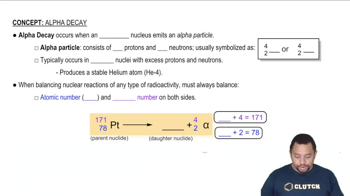
An alpha particle is composed of two protons and two neutrons.
Track progress
Control buttons has been changed to "navigation" mode.
1/15
Related flashcards
Related practice
Recommended videos
Alpha Decay definitions
Alpha Decay
15 Terms
Alpha Decay
11. Nuclear Chemistry
3 problems
Topic
Jules
Beta Decay
11. Nuclear Chemistry
3 problems
Topic
Jules
11. Nuclear Chemistry - Part 1 of 2
4 topics
9 problems
Chapter
Jules
11. Nuclear Chemistry - Part 2 of 2
4 topics
9 problems
Chapter
Jules
Guided course
01:13
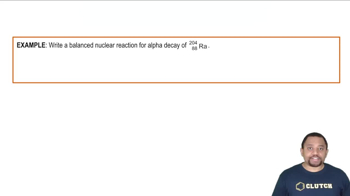
Alpha Decay Example
197
views
8
rank
Guided course
03:53
Alpha Decay
4112
views
28
rank
1
comments
Guided course
01:22
Alpha Decay Reaction Example
4073
views
22
rank
Terms in this set (15)
Hide definitions
What is an alpha particle composed of?
An alpha particle is composed of two protons and two neutrons.
How does alpha decay affect the atomic mass and atomic number of a nucleus?
Alpha decay decreases the atomic mass by 4 and the atomic number by 2.
Which element can be used to represent an alpha particle in nuclear equations?
Helium can be used to represent an alpha particle because it has an atomic mass of 4 and atomic number of 2.
What is the symbol for an alpha particle in nuclear reactions?
The symbol for an alpha particle is either 4/2 α or 4/2 He.
What happens to polonium-210 when it undergoes alpha decay?
Polonium-210 emits an alpha particle and becomes lead-206.
Why must nuclear equations be balanced in terms of atomic mass and atomic number?
Nuclear equations must be balanced so that the sum of atomic masses and atomic numbers is equal on both sides.
What is the atomic number and mass of curium used in the example?
Curium has an atomic number of 96 and an atomic mass of 248 in the example.
What new element is formed when curium-248 undergoes alpha decay?
Curium-248 emits an alpha particle and becomes plutonium-244.
What is the result of bismuth-207 undergoing alpha decay?
Bismuth-207 emits an alpha particle and becomes thallium-203.
What is the difference between alpha emission and alpha capture?
Alpha emission produces an alpha particle as a product, while alpha capture involves the alpha particle as a reactant.
How do you determine the new element formed after alpha decay?
Subtract 4 from the atomic mass and 2 from the atomic number, then use the periodic table to identify the new element.
What are isotopes and how do they relate to alpha decay?
Isotopes are atoms with the same atomic number but different atomic masses, and alpha decay can occur with different isotopes.
Why are alpha particles considered highly damaging to biological cells?
Alpha particles have the highest ionizing power, making them very damaging to biological cells.
Why do alpha particles have low penetrating power?
Alpha particles are large and cannot easily penetrate materials or enter the body from outside.
What is the risk of internal exposure to alpha particles?
Internal exposure to alpha particles greatly reduces chances of survival due to their high ionizing power.
 BackBack
 01:13
01:13