Skip to main content
GOB Chemistry
My Course
Learn
Exam Prep
AI Tutor
Study Guides
Textbook Solutions
Flashcards
Explore
Try the app
My Course
Learn
Exam Prep
AI Tutor
Study Guides
Textbook Solutions
Flashcards
Explore
Try the app
Back
Amino Acid Classifications definitions
You can tap to flip the card.
Nonpolar Amino Acids
You can tap to flip the card.
👆
Nonpolar Amino Acids
Group with hydrophobic side chains that avoid water, remembered by the mnemonic 'Gav trip fell limping'.
Track progress
Control buttons has been changed to "navigation" mode.
1/15
Related flashcards
Related practice
Recommended videos
Amino Acid Classifications quiz
Amino Acid Classifications
15 Terms
Amino Acid Classifications
18. Amino Acids and Proteins
7 problems
Topic
Jules
Peptides
18. Amino Acids and Proteins
7 problems
Topic
Jules
18. Amino Acids and Proteins - Part 1 of 2
6 topics
13 problems
Chapter
Jules
18. Amino Acids and Proteins - Part 2 of 2
5 topics
13 problems
Chapter
Jules
Guided course
4:00
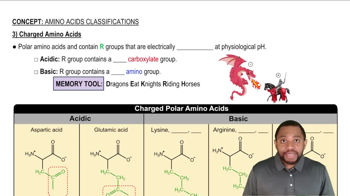
Charged Amino Acids Concept 3
3334
views
4
rank
Guided course
1:33
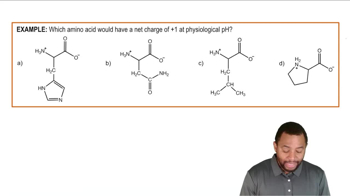
Amino Acid Classifications Example 3
3306
views
2
rank
Guided course
1:49
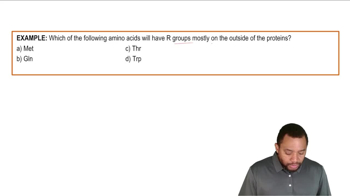
Amino Acid Classifications Example 2
3095
views
3
rank
1
comments
Terms in this set (15)
Hide definitions
Nonpolar Amino Acids
Group with hydrophobic side chains that avoid water, remembered by the mnemonic 'Gav trip fell limping'.
Polar Amino Acids
Group with hydrophilic side chains, often forming hydrogen bonds with water, except for cysteine.
Charged Amino Acids
Group with side chains carrying a positive or negative charge at physiological pH, further divided into acidic and basic.
Hydrophobicity
Property causing molecules to avoid water, typical of nonpolar amino acid side chains.
Hydrophilicity
Property causing molecules to interact with water, typical of polar amino acid side chains.
R Group
Variable side chain attached to the alpha carbon, determining amino acid classification and properties.
Mnemonic
Memory aid using phrases or words to help recall amino acid groups, such as 'Gav trip fell limping'.
Acidic Amino Acids
Subset with negatively charged side chains at physiological pH, including aspartate and glutamate.
Basic Amino Acids
Subset with positively charged side chains at physiological pH, including lysine, arginine, and histidine.
Physiological pH
Typical cellular pH where amino acid side chains may gain or lose protons, affecting their charge.
Hydrogen Bond
Attractive interaction between a hydrogen atom and an electronegative atom, common in polar amino acids.
Thiol Group
Functional group containing sulfur and hydrogen, present in cysteine's side chain.
Amide Group
Functional group with a carbonyl and nitrogen, found in asparagine and glutamine side chains.
Carboxylate Group
Negatively charged group derived from carboxylic acid, present in acidic amino acid side chains.
Amino Group
Nitrogen-containing group that can carry a positive charge in basic amino acid side chains.
 BackBack
 4:00
4:00