Back

Atomic, Ionic and Molecular Solids definitions

Control buttons has been changed to "navigation" mode.
1/15
  • Crystalline Solid

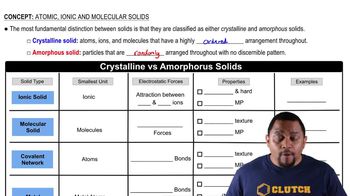
    Structure with atoms, ions, or molecules arranged in a highly ordered, repeating pattern throughout the material.
  • Amorphous Solid

    Material with randomly arranged particles, lacking a regular pattern and a distinct melting point, yet able to flow.
  • Ionic Solid

    Substance composed of positive and negative ions held together by strong electrostatic attractions, typically hard and brittle.
  • Molecular Solid

    Material made up of molecules held by intermolecular forces, generally soft with low to moderate melting points.
  • Covalent Network Solid

    Substance where atoms are interconnected by covalent bonds, resulting in extreme hardness and very high melting points.
  • Metal

    Elemental solid with atoms bonded by a shared electron pool, often shiny, and ranging from soft to hard textures.
  • Electrostatic Force

    Attractive interaction between charged particles, such as ions, responsible for holding certain solids together.
  • Intermolecular Force

    Attraction between molecules in a solid, influencing properties like texture and melting point.
  • Covalent Bond

    Strong connection formed by the sharing of electron pairs between atoms, creating a rigid structure.
  • Metallic Bond

    Attraction between metal atoms and a sea of delocalized electrons, giving rise to properties like luster and conductivity.
  • Luster

    Shiny appearance characteristic of metals due to their interaction with light and electron movement.
  • Polymers

    Large molecules composed of repeating structural units, often found in amorphous solids like plastics.
  • Melting Point

    Temperature at which a solid transitions to a liquid; varies widely among different types of solids.
  • Brittleness

    Tendency of a material to break or shatter without significant deformation, common in ionic solids.
  • Hardness

    Resistance to scratching or deformation, especially notable in covalent network and ionic solids.