Back

Atomic Mass (Simplified) quiz

Control buttons has been changed to "navigation" mode.
1/15
  • What does the atomic number on the periodic table represent?

    The atomic number represents the number of protons in an element.
  • Why are atomic masses on the periodic table usually not whole numbers?

    Atomic masses are averages of all the isotopes of an element, which results in non-whole numbers.
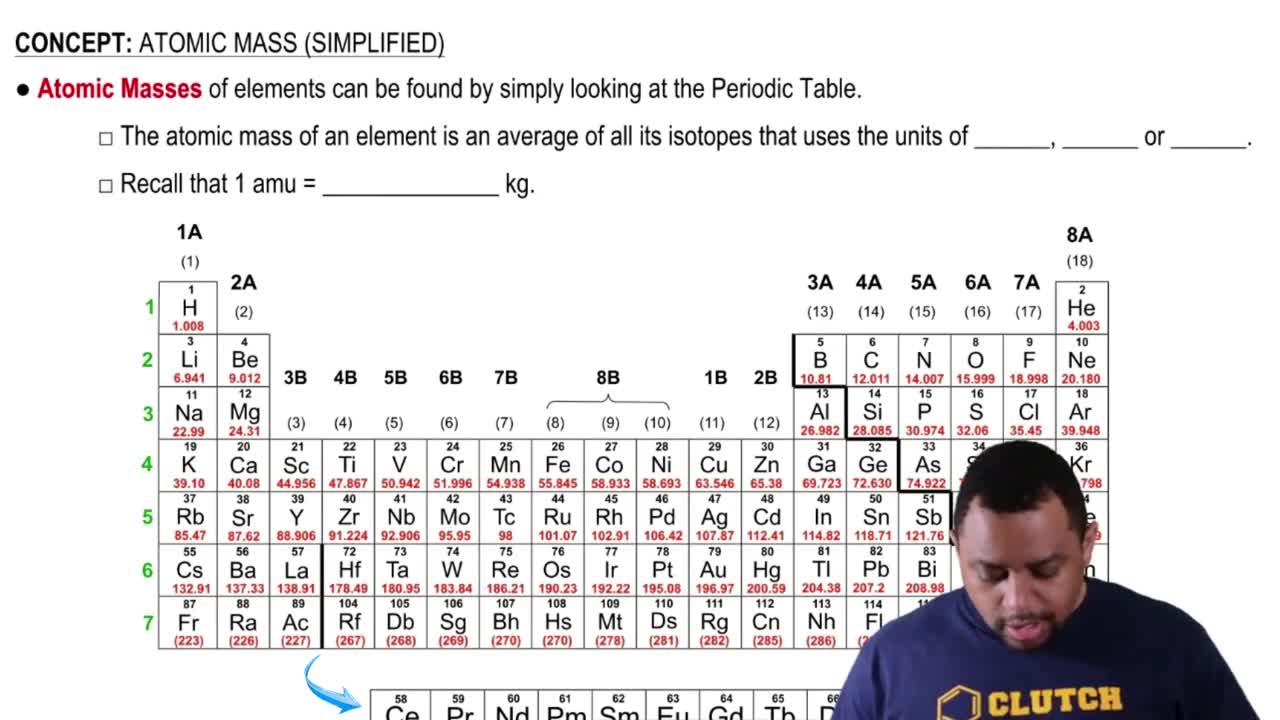
  • What units can atomic mass be measured in?

    Atomic mass can be measured in grams per mole, AMU (atomic mass units), or Daltons.
  • What is the value of 1 AMU in kilograms?

    1 AMU is equal to 1.66 x 10^-27 kilograms.
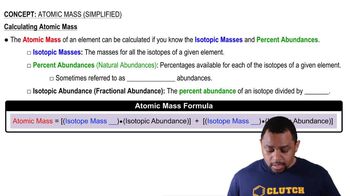
  • What are isotopic masses?

    Isotopic masses are the individual masses of each isotope of an element.
  • What does percent abundance (or natural abundance) indicate?

    Percent abundance indicates the relative proportion of each isotope of an element.
  • How do you convert percent abundance to isotopic (fractional) abundance?

    Divide the percent abundance by 100 to convert it to a decimal (fractional) form.
  • What is the formula for calculating the atomic mass of an element?

    Atomic mass = sum of (isotopic mass of each isotope × its isotopic abundance).
  • How would you modify the atomic mass formula for an element with more than two isotopes?

    You add more terms for each additional isotope: isotopic mass × isotopic abundance for each isotope.
  • What is another term for isotopic abundance?

    Isotopic abundance is also called fractional abundance.
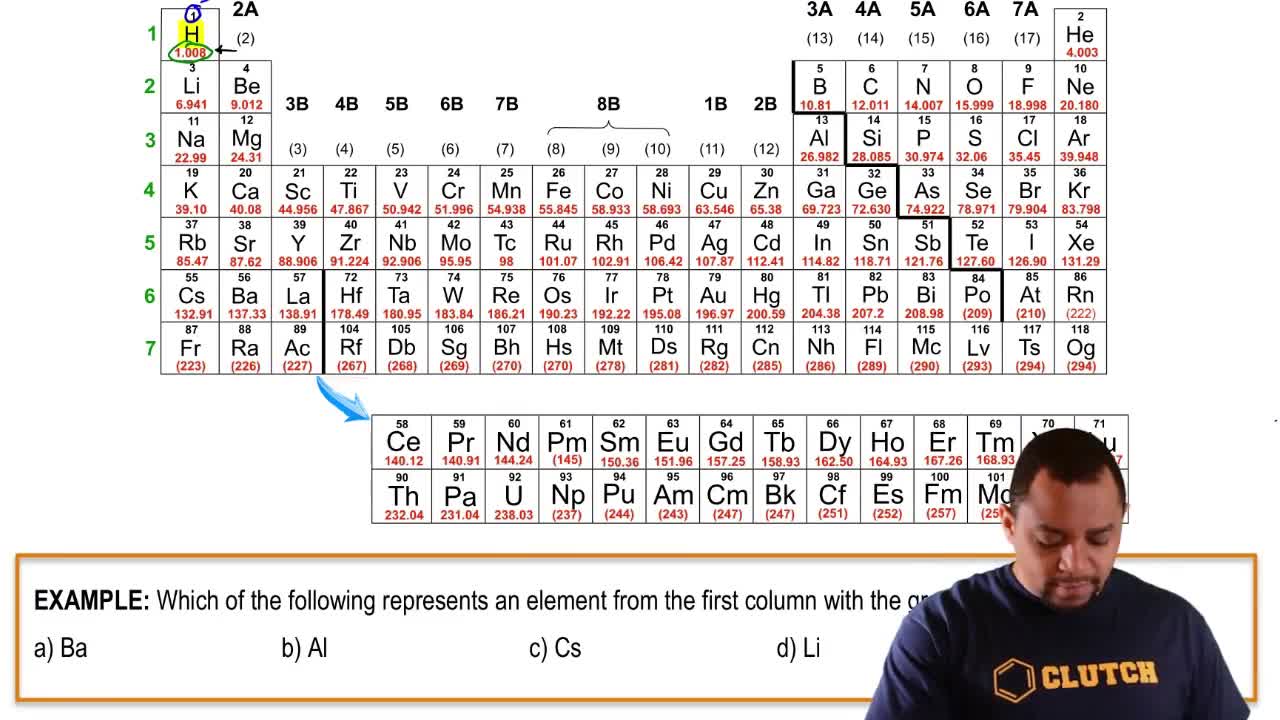
  • Where can you find the atomic mass of an element?

    You can find the atomic mass of an element by looking it up on the periodic table.
  • What do the whole numbers on the periodic table typically represent?

    The whole numbers represent the atomic number, or the number of protons.
  • What is the significance of the atomic mass being an average?

    It reflects the weighted average of all naturally occurring isotopes of that element.
  • What is meant by 'percent natural abundance'?

    It is another term for percent abundance, indicating the percentage of each isotope found in nature.
  • Why might the atomic mass formula for manganese be larger than for hydrogen?

    Manganese has more isotopes, so the formula includes more terms for each isotope's mass and abundance.