Back

Balancing Chemical Equations (Simplified) definitions

Control buttons has been changed to "navigation" mode.
1/13
  • Chemical Equation

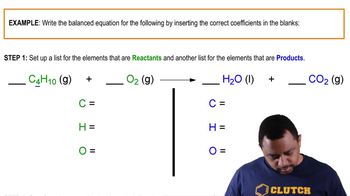
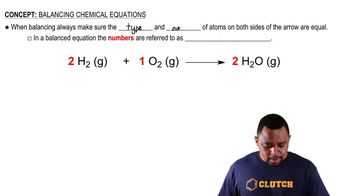
    A symbolic representation showing reactants and products with their respective quantities in a chemical reaction.
  • Coefficient

    A number placed before a molecule or atom in an equation, indicating how many units are involved in the reaction.
  • Atom

    The smallest unit of an element, whose type and quantity must be equal on both sides of a balanced equation.
  • Reactant

    A substance present on the left side of a chemical equation, participating in the reaction.
  • Product

    A substance formed and shown on the right side of a chemical equation after the reaction.
  • Arrow

    A symbol in a chemical equation separating reactants from products, indicating the direction of the reaction.
  • Balanced Equation

    A state where both the type and number of atoms are identical on each side of the chemical equation.
  • Distribution

    The process of applying a coefficient to all atoms in a molecule, adjusting their total count in the equation.
  • Hydrogen

    An element commonly used in balancing examples, whose atom count must be equal on both sides of the equation.
  • Oxygen

    A diatomic element often involved in balancing, requiring careful adjustment of its atom count in equations.
  • Molecule

    A group of atoms bonded together, whose quantity is modified by coefficients in chemical equations.
  • Quantity

    The total number of atoms or molecules present, determined by multiplying subscripts by coefficients.
  • Subscript

    A small number written after an element symbol, indicating how many atoms of that element are in a molecule.