Back

Base Pairing quiz

Control buttons has been changed to "navigation" mode.
1/15
  • What type of intermolecular force is responsible for stabilizing DNA and RNA structures?

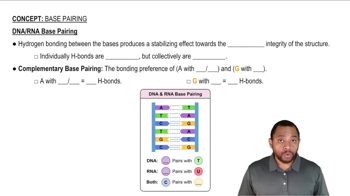
    Hydrogen bonding is responsible for stabilizing DNA and RNA structures.
  • Are individual hydrogen bonds in DNA strong or weak?

    Individually, hydrogen bonds are relatively weak.
  • Why are hydrogen bonds collectively strong in DNA?

    Because there are so many hydrogen bonds in DNA, their collective effect is strong and stabilizes the molecule.
  • What is complementary base pairing?

    Complementary base pairing refers to the specific hydrogen bonding preferences between bases in DNA and RNA.
  • Which bases pair together in DNA?

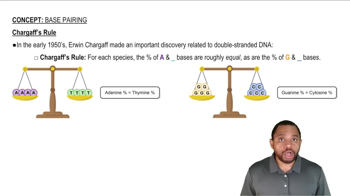
    In DNA, Adenine (A) pairs with Thymine (T), and Guanine (G) pairs with Cytosine (C).
  • Which bases pair together in RNA?

    In RNA, Adenine (A) pairs with Uracil (U), and Guanine (G) pairs with Cytosine (C).
  • How many hydrogen bonds form between Adenine and Thymine?

    Adenine and Thymine form two hydrogen bonds.
  • How many hydrogen bonds form between Guanine and Cytosine?

    Guanine and Cytosine form three hydrogen bonds.
  • Which base replaces Thymine in RNA?

    Uracil replaces Thymine in RNA.
  • Does Adenine pair with Thymine in RNA?

    No, in RNA, Adenine pairs with Uracil instead of Thymine.
  • Which base pairing provides greater stability in DNA or RNA, A-T/U or G-C?

    G-C pairing provides greater stability because it forms three hydrogen bonds.
  • What is the significance of regions in DNA with many G-C pairs?

    Regions with many G-C pairs are areas of increased strength due to more hydrogen bonds.
  • Does Cytosine ever pair with a base other than Guanine?

    No, Cytosine always pairs with Guanine in both DNA and RNA.
  • What is the main difference in base pairing between DNA and RNA?

    The main difference is that DNA uses Thymine, while RNA uses Uracil to pair with Adenine.
  • Why is hydrogen bonding important for nucleic acids?

    Hydrogen bonding is important because it stabilizes the structure and integrity of DNA and RNA.