Skip to main content
GOB Chemistry
My Course
Learn
Exam Prep
AI Tutor
Study Guides
Textbook Solutions
Flashcards
Explore
Try the app
My Course
Learn
Exam Prep
AI Tutor
Study Guides
Textbook Solutions
Flashcards
Explore
Try the app
Back
Beta Decay definitions
You can tap to flip the card.
Beta Decay
You can tap to flip the card.
👆
Beta Decay
A process where an unstable nucleus releases a beta particle, changing its atomic number but not its atomic mass.
Track progress
Control buttons has been changed to "navigation" mode.
1/15
Related flashcards
Related practice
Recommended videos
Beta Decay quiz
Beta Decay
15 Terms
Beta Decay
11. Nuclear Chemistry
3 problems
Topic
Jules
Gamma Emission
11. Nuclear Chemistry
3 problems
Topic
Jules
11. Nuclear Chemistry - Part 1 of 2
4 topics
9 problems
Chapter
Jules
11. Nuclear Chemistry - Part 2 of 2
4 topics
9 problems
Chapter
Jules
Guided course
02:32
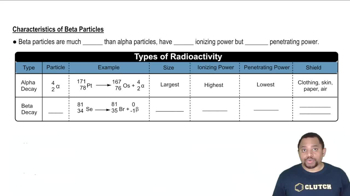
Characteristics of Beta Particles
4059
views
16
rank
Guided course
01:02
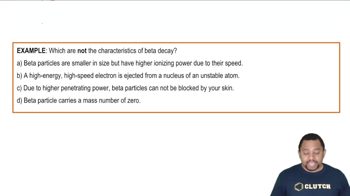
Characteristics of Beta Particles Example
4163
views
25
rank
2
comments
Guided course
03:01
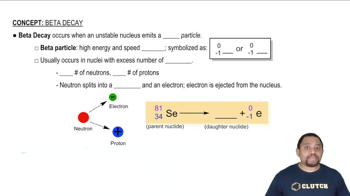
Beta Decay
4389
views
20
rank
Terms in this set (15)
Hide definitions
Beta Decay
A process where an unstable nucleus releases a beta particle, changing its atomic number but not its atomic mass.
Beta Particle
A subatomic particle identical to an electron, emitted from a nucleus during radioactive transformation.
Electron
A negatively charged subatomic particle with negligible mass, represented by atomic number -1 in nuclear equations.
Atomic Mass
The total number of protons and neutrons in a nucleus, remaining unchanged during beta decay.
Atomic Number
A value indicating the number of protons in a nucleus, which increases by one after beta emission.
Nucleus
The dense central region of an atom where beta decay originates, containing protons and neutrons.
Radioactive Particle
A general term for particles, such as alpha or beta, emitted during nuclear transformations.
Alpha Particle
A large, highly ionizing radioactive particle, more damaging but less penetrating than a beta particle.
Ionizing Power
A measure of a particle's ability to remove electrons from atoms, lower for beta particles than for alpha particles.
Penetrating Power
A property describing how deeply a particle can pass through materials, higher for beta particles than for alpha particles.
Nuclear Equation
A symbolic representation showing the balance of atomic numbers and masses before and after a nuclear event.
Product
A substance or particle that appears on the right side of a nuclear equation, such as a beta particle in beta emission.
Reactant
A substance or particle present on the left side of a nuclear equation, involved before the transformation.
Periodic Table
A chart organizing elements by atomic number, used to identify elements formed during nuclear changes.
Thallium-201
An isotope formed when mercury-201 undergoes beta decay, having an atomic number one greater than mercury.
 BackBack
 02:32
02:32