Skip to main content
GOB Chemistry
My Course
Learn
Exam Prep
AI Tutor
Study Guides
Textbook Solutions
Flashcards
Explore
Try the app
My Course
Learn
Exam Prep
AI Tutor
Study Guides
Textbook Solutions
Flashcards
Explore
Try the app
Back
Beta Decay quiz
You can tap to flip the card.
What is emitted during beta decay?
You can tap to flip the card.
👆
What is emitted during beta decay?
An electron, also called a beta particle, is emitted during beta decay.
Track progress
Control buttons has been changed to "navigation" mode.
1/15
Related flashcards
Related practice
Recommended videos
Beta Decay definitions
Beta Decay
15 Terms
Beta Decay
11. Nuclear Chemistry
3 problems
Topic
Jules
Gamma Emission
11. Nuclear Chemistry
3 problems
Topic
Jules
11. Nuclear Chemistry - Part 1 of 2
4 topics
9 problems
Chapter
Jules
11. Nuclear Chemistry - Part 2 of 2
4 topics
9 problems
Chapter
Jules
Guided course
02:32
Characteristics of Beta Particles
4063
views
16
rank
Guided course
01:02
Characteristics of Beta Particles Example
4164
views
25
rank
2
comments
Guided course
03:01
Beta Decay
4391
views
20
rank
Terms in this set (15)
Hide definitions
What is emitted during beta decay?
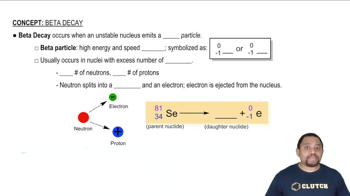
An electron, also called a beta particle, is emitted during beta decay.
How is a beta particle represented in nuclear equations?
A beta particle is represented as an electron (E) with atomic mass 0 and atomic number -1.
What is the atomic mass of a beta particle?
The atomic mass of a beta particle (electron) is approximately 0.
What is the atomic number of a beta particle?
The atomic number of a beta particle is -1.
How must atomic masses and atomic numbers balance in beta decay equations?
Atomic masses and atomic numbers must be equal on both sides of the equation.
What happens to the atomic number of an element after beta decay?
The atomic number increases by 1 after beta decay.
What happens to the atomic mass of an element after beta decay?
The atomic mass remains unchanged after beta decay.
What is the product when mercury-201 undergoes beta decay?
Thallium-201 (atomic number 81) is produced when mercury-201 (atomic number 80) undergoes beta decay.
How does the size of beta particles compare to alpha particles?
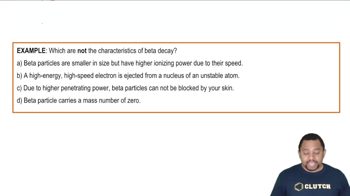
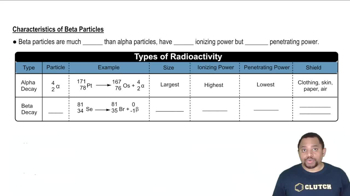
Beta particles are smaller than alpha particles.
Are beta particles more or less damaging if ingested compared to alpha particles?
Beta particles are less damaging if ingested compared to alpha particles.
How does the ionizing power of beta particles compare to alpha particles?
Beta particles have lower ionizing power than alpha particles.
How does the penetrating power of beta particles compare to alpha particles?
Beta particles have greater penetrating power than alpha particles.
What materials can protect against beta particles?
A sheet of metal or a large block of wood can protect against beta particles.
What is the new element formed when magnesium-25 undergoes beta decay?
Aluminum-25 (atomic number 13) is formed when magnesium-25 (atomic number 12) undergoes beta decay.
What is the new element formed when ruthenium-102 undergoes beta decay?
Rhodium-102 (atomic number 45) is formed when ruthenium-102 (atomic number 44) undergoes beta decay.
 BackBack
 02:32
02:32