Back

Boiling Point Elevation quiz

Control buttons has been changed to "navigation" mode.
1/15
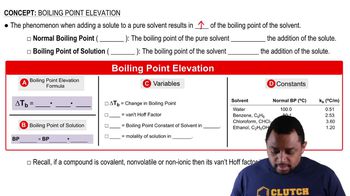
  • What happens to the boiling point of a solvent when a solute is added?

    The boiling point of the solvent increases when a solute is added.
  • What is the normal boiling point (bp) of a solvent?

    The normal boiling point is the boiling point of the pure solvent before any solute is added.
  • How is the boiling point of a solution (bp solution) defined?

    The boiling point of a solution is the boiling point of the solvent after a solute has been added.
  • What is the formula for boiling point elevation?

    The formula is Δt_b = i × k_b × m, where i is the van't Hoff factor, k_b is the boiling point constant, and m is the molality.
  • What does the van't Hoff factor (i) represent in the boiling point elevation formula?

    The van't Hoff factor represents the number of particles the solute splits into in solution.
  • What is the unit for the boiling point constant (k_b)?

    The unit for k_b is degrees Celsius per molality (°C/m).
  • How is molality (m) defined in the context of boiling point elevation?

    Molality is the number of moles of solute per kilogram of solvent.
  • How do you calculate the boiling point of a solution using the boiling point elevation?

    Add the normal boiling point of the pure solvent to the boiling point elevation (Δt_b).
  • Name four common solvents used in boiling point elevation problems.

    Water, benzene, chloroform, and ethanol are commonly used solvents.
  • What happens to the boiling point of a solvent as more solute is added?

    The boiling point increases as more solute is added.
  • What is the van't Hoff factor (i) for a non-volatile, non-ionic, or covalent compound?

    For these compounds, the van't Hoff factor is 1.
  • Why do you not need to memorize the k_b values for common solvents?

    Because these values are usually provided in questions involving colligative properties.
  • What is the effect of adding a solute to a solvent on the boiling point compared to the pure solvent?

    The boiling point of the solution will be higher than that of the pure solvent.
  • What property of solutions does boiling point elevation illustrate?

    Boiling point elevation is an example of a colligative property.
  • What is the relationship between the amount of solute and the magnitude of boiling point elevation?

    The more solute added, the greater the boiling point elevation.