GOB Chemistry
My Course
Learn
Exam Prep
AI Tutor
Study Guides
Textbook Solutions
Flashcards
Explore
My Course
Learn
Exam Prep
AI Tutor
Study Guides
Textbook Solutions
Flashcards
Explore
Back
Bond Angles (Simplified) quiz
You can tap to flip the card.
Define:
What is a bond angle in a molecule?
You can tap to flip the card.
👆
What is a bond angle in a molecule?
A bond angle is the angle formed by two adjacent neighboring atoms in a molecule, measured at the central atom.
Track progress
Control buttons has been changed to "navigation" mode.
1/15
Related flashcards
Related practice
Recommended videos
Bond Angles (Simplified) definitions
Bond Angles (Simplified)
14 Terms
Bond Angles (Simplified)
4. Molecular Compounds
2 problems
Topic

Jules
Dipole Moment (Simplified)
4. Molecular Compounds
7 problems
Topic
Jules
4. Molecular Compounds - Part 1 of 2
8 topics
13 problems
Chapter
Jules
4. Molecular Compounds - Part 2 of 2
8 topics
12 problems
Chapter
Jules
Guided course
01:24
Bond Angles (Simplified) Concept 1
Jules
2870
views
7
rank
Guided course
01:24
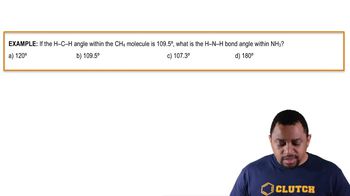
Bond Angles (Simplified) Example 1
Jules
2799
views
2
rank
Guided course
02:14
Bond Angles (Simplified) Concept 2
Jules
2659
views
7
rank
Terms in this set (15)
Hide definitions
What is a bond angle in a molecule?
A bond angle is the angle formed by two adjacent neighboring atoms in a molecule, measured at the central atom.
How does the presence of lone pairs on the central atom affect bond angles?
Lone pairs on the central atom decrease the bond angle from its ideal value due to increased electron repulsion.
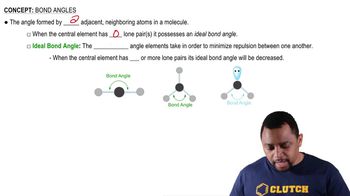
What is meant by an 'ideal bond angle'?
An ideal bond angle occurs when the central atom has zero lone pairs, minimizing repulsion between bonding electron groups.
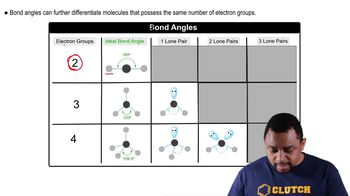
What is the ideal bond angle for a molecule with two electron groups?
The ideal bond angle for two electron groups is 180°, as there are no lone pairs possible.
What is the ideal bond angle for a molecule with three electron groups and no lone pairs?
The ideal bond angle for three electron groups with no lone pairs is 120°.
How does the bond angle change when there is one lone pair among three electron groups?
The bond angle decreases from the ideal 120° and is less than 120° when there is one lone pair.
What is the ideal bond angle for a molecule with four electron groups and no lone pairs?
The ideal bond angle for four electron groups with no lone pairs is 109.5°.
How does the bond angle change with one lone pair among four electron groups?
The bond angle decreases from the ideal 109.5° and is less than 109.5° when there is one lone pair.
What happens to the bond angle when there are two lone pairs among four electron groups?
The bond angle becomes even less than 109.5°, decreasing further due to the presence of two lone pairs.
Why do lone pairs cause bond angles to decrease?
Lone pairs cause bond angles to decrease because they create greater electron repulsion than bonding pairs.
How can bond angles help differentiate molecules with the same number of electron groups?
Bond angles can differentiate molecules because the presence and number of lone pairs affect the actual bond angle.
What is the bond angle for a molecule with two bonding groups and one lone pair among three electron groups?
The bond angle is less than 120° due to the lone pair's repulsion.
What is the bond angle for a molecule with two bonding groups and two lone pairs among four electron groups?
The bond angle is less than 109.5°, and even smaller than with just one lone pair.
What is the general trend for bond angles as the number of lone pairs increases?
As the number of lone pairs increases, the bond angle decreases further from its ideal value.
What is the relationship between lone pairs and electron repulsion in determining bond angles?
Lone pairs increase electron repulsion, which causes bond angles to decrease from their ideal values.