Back

Bonding Preferences definitions

Control buttons has been changed to "navigation" mode.
1/13
  • Bonding Preferences

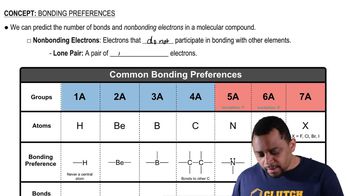
    Tendency of elements to form a specific number of bonds based on group number or electrons needed for stability.
  • Group Number

    Numerical label for columns in the periodic table, indicating valence electron count for main group elements.
  • Valence Electrons

    Electrons in the outermost shell that determine an element’s chemical bonding behavior.
  • Octet Rule

    Guideline stating atoms tend to achieve eight electrons in their valence shell for stability.
  • Lone Pair

    Pair of nonbonding electrons localized on an atom, not shared with other atoms.
  • Halogen

    Element from group 7a, such as fluorine or chlorine, typically forming one bond and possessing three lone pairs.
  • Molecular Compound

    Substance composed of two or more nonmetals bonded together, often following specific bonding preferences.
  • Nonbonding Electrons

    Electrons not involved in forming chemical bonds, often found as lone pairs.
  • Central Atom

    Atom located at the center of a molecular structure, never occupied by hydrogen.
  • Stable Electron Configuration

    Arrangement of electrons that provides maximum stability, often achieved by following the octet rule.
  • Surrounding Element

    Atom bonded to the central atom in a molecule, such as halogens or hydrogen.
  • Representative Element

    Element from groups 1a to 7a, exhibiting predictable bonding patterns based on group number.
  • Variable X

    Symbol used to represent any halogen element in chemical formulas or diagrams.