Skip to main content
GOB Chemistry
My Course
Learn
Exam Prep
AI Tutor
Study Guides
Textbook Solutions
Flashcards
Explore
Try the app
My Course
Learn
Exam Prep
AI Tutor
Study Guides
Textbook Solutions
Flashcards
Explore
Try the app
Back
Cell Membranes definitions
You can tap to flip the card.
Cell Membrane
You can tap to flip the card.
👆
Cell Membrane
Boundary separating cell interior from external environment, composed mainly of lipids, proteins, and carbohydrates.
Track progress
Control buttons has been changed to "navigation" mode.
1/14
Related flashcards
Related practice
Recommended videos
Cell Membranes quiz
Cell Membranes
15 Terms
Cell Membranes
23. Lipids
3 problems
Topic
Nicole
Membrane Transport
23. Lipids
5 problems
Topic
Nicole
23. Lipids - Part 1 of 3
6 topics
13 problems
Chapter
Ernest
23. Lipids - Part 2 of 3
6 topics
12 problems
Chapter
Nicole
23. Lipids - Part 3 of 3
1 topic
3 problems
Chapter
Guided course
0:50
Cell Membranes Concept 1
3255
views
1
rank
Guided course
1:00
Cell Membranes Example 1
3220
views
2
rank
Guided course
2:34
Cell Membranes Concept 2
3253
views
1
rank
Terms in this set (14)
Hide definitions
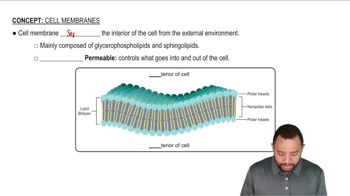
Cell Membrane
Boundary separating cell interior from external environment, composed mainly of lipids, proteins, and carbohydrates.
Glycerophospholipid
Major lipid component with polar heads and non-polar tails, forming the basic structure of the bilayer.
Sphingolipid
Lipid found in membranes, contributing to structure and function alongside glycerophospholipids.
Lipid Bilayer
Double-layered arrangement with hydrophilic heads outward and hydrophobic tails inward, enabling selective permeability.
Polar Head
Hydrophilic region of a membrane lipid, oriented toward the cell's exterior and interior surfaces.
Non-polar Tail
Hydrophobic fatty acid chains of membrane lipids, positioned in the bilayer's interior.
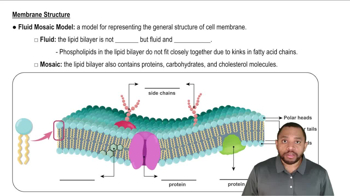
Fluid Mosaic Model
Concept describing the dynamic, flexible nature of the membrane with diverse molecules embedded within.
Integral Protein
Membrane protein spanning the entire bilayer, present on both sides, often involved in transport.
Peripheral Protein
Membrane-associated protein attached to only one side of the bilayer, not spanning across.
Carbohydrate Side Chain
Extracellular projections from membrane lipids or proteins, crucial for cell recognition and communication.
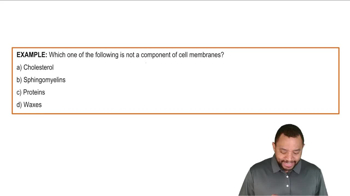
Cholesterol
Steroid molecule with four fused rings, embedded in the bilayer, enhancing membrane strength and stability.
Selective Permeability
Property allowing the membrane to control which substances enter or exit the cell.
Hydrophobic Tail
Water-repelling portion of membrane lipids, forming the bilayer's inner core.
Hydrophilic Head
Water-attracting portion of membrane lipids, facing the aqueous environments inside and outside the cell.
 BackBack

 0:50
0:50