What are the main lipid components of the cell membrane?
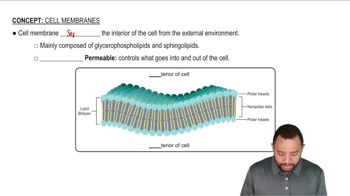
The main lipid components are glycerophospholipids and sphingolipids.
What does it mean that the cell membrane is selectively permeable?
It means the membrane controls what substances can enter and exit the cell.
How are the phospholipids arranged in the lipid bilayer?
Phospholipids have polar heads facing the exterior and interior surfaces, with non-polar tails in the center.
What is the fluid mosaic model?
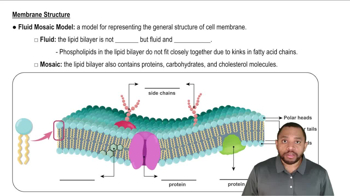
The fluid mosaic model describes the cell membrane as a dynamic, fluid structure with various molecules like proteins and cholesterol embedded in the lipid bilayer.
Why is the cell membrane described as 'fluid'?
Because the phospholipids do not fit closely together due to kinks in their fatty acid chains, making the membrane flexible and dynamic.
What does the 'mosaic' part of the fluid mosaic model refer to?
It refers to the presence of proteins, carbohydrates, and cholesterol interspersed within the lipid bilayer.
What is the function of integral proteins in the cell membrane?
Integral proteins span the entire bilayer and appear on both sides of the membrane.
How do peripheral proteins differ from integral proteins?
Peripheral proteins are associated with only one side of the membrane and do not span the bilayer.
What role do carbohydrate side chains play in the cell membrane?
Carbohydrate side chains project into the extracellular fluid and are involved in cell recognition and communication.
Where is cholesterol found in the cell membrane, and what is its function?
Cholesterol is found within the bilayer and increases membrane strength and stability.
What structural feature identifies cholesterol in the membrane?
Cholesterol is identified by its four fused ring structure.
What part of the phospholipid is hydrophobic?
The non-polar tails of the phospholipid are hydrophobic.
What part of the phospholipid is hydrophilic?
The polar heads of the phospholipid are hydrophilic.
How does the lipid bilayer contribute to selective permeability?
The arrangement of hydrophilic heads and hydrophobic tails allows only certain substances to pass through the membrane.
Why do phospholipids in the membrane not fit closely together?
They do not fit closely together because of kinks in their fatty acid chains, which increases membrane fluidity.
 Back
Back

 0:50
0:50