Back

Chemical Equilibrium definitions

Control buttons has been changed to "navigation" mode.
1/13
  • Chemical Equilibrium

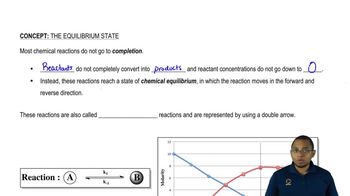
    A state where reactant and product concentrations remain constant as forward and reverse reactions occur at equal rates.
  • Completion

    A scenario in which all reactants are fully converted into products, leaving no reactant remaining.
  • Reactant

    A substance present at the start of a reaction, which is partially converted into products during the process.
  • Product

    A substance formed from reactants, whose amount increases until equilibrium is reached.
  • Reversible Reaction

    A process where reactants convert to products and products can also revert back to reactants.
  • Double Arrow

    A notation indicating that a reaction proceeds in both forward and reverse directions.
  • Forward Direction

    The process in which reactants are transformed into products, typically represented by a right-facing arrow.
  • Reverse Direction

    The process in which products convert back into reactants, often shown with a left-facing arrow.
  • Rate Constant

    A proportionality factor (such as k1 or k-1) that quantifies the speed of a reaction in a specific direction.
  • k1

    A symbol representing the rate constant for the forward reaction, indicating how quickly reactants form products.
  • k-1

    A symbol representing the rate constant for the reverse reaction, indicating how quickly products revert to reactants.
  • Plateau

    A point on a concentration graph where reactant and product levels become steady, signaling equilibrium.
  • Concentration

    The amount of a substance present in a given volume, which stabilizes for both reactants and products at equilibrium.