Skip to main content
GOB Chemistry
My Course
Learn
Exam Prep
AI Tutor
Study Guides
Textbook Solutions
Flashcards
Explore
Try the app
My Course
Learn
Exam Prep
AI Tutor
Study Guides
Textbook Solutions
Flashcards
Explore
Try the app
Back
Chromatography definitions
You can tap to flip the card.
Chromatography
You can tap to flip the card.
👆
Chromatography
A laboratory method for separating mixture components based on their molecular attractions to different phases.
Track progress
Control buttons has been changed to "navigation" mode.
1/15
Related flashcards
Related practice
Recommended videos
Chromatography quiz
Chromatography
15 Terms
Chromatography
BONUS: Lab Techniques and Procedures
4 problems
Topic
Filtration and Evaporation
BONUS: Lab Techniques and Procedures
4 problems
Topic
BONUS: Lab Techniques and Procedures - Part 1 of 2
5 topics
9 problems
Chapter
BONUS: Lab Techniques and Procedures - Part 2 of 2
2 topics
4 problems
Chapter
Guided course
04:50
Chromatography
5471
views
12
rank
Terms in this set (15)
Hide definitions
Chromatography
A laboratory method for separating mixture components based on their molecular attractions to different phases.
Stationary Phase
The non-moving solid surface, often a silica plate, that holds the mixture and interacts with its components.
Mobile Phase
The moving liquid, such as a solvent, that carries mixture components up the plate by capillary action.
Silica Plate
A flat, solid support used as the base for separating mixtures in thin layer chromatography.
Solvent
A liquid mixture, often combining polar and non-polar substances, that moves up the plate and affects separation.
Affinity
The degree of attraction a compound has for either the stationary or mobile phase, influencing its movement.
Capillary Action
The process by which the solvent rises up the plate, enabling the movement of mixture components.
TLC Plate
A thin layer of silica on a flat surface used to visualize and separate mixture components.
Polarity
A property describing how molecules interact with solvents, affecting how far they travel during separation.
RF Value
A ratio comparing the distance a compound travels to the distance the solvent front moves, used for identification.
Solvent Front
The furthest point reached by the mobile phase on the plate, used as a reference for calculations.
Reference Manual
A guide listing known RF values for compounds, aiding in the identification of separated mixture components.
Mixture
A combination of different substances applied to the plate for separation based on their chemical properties.
Component
An individual substance within a mixture that can be separated and identified using chromatography.
Hydrocarbon
A non-polar compound, such as hexanes, often used in the solvent mixture to influence separation.
 BackBack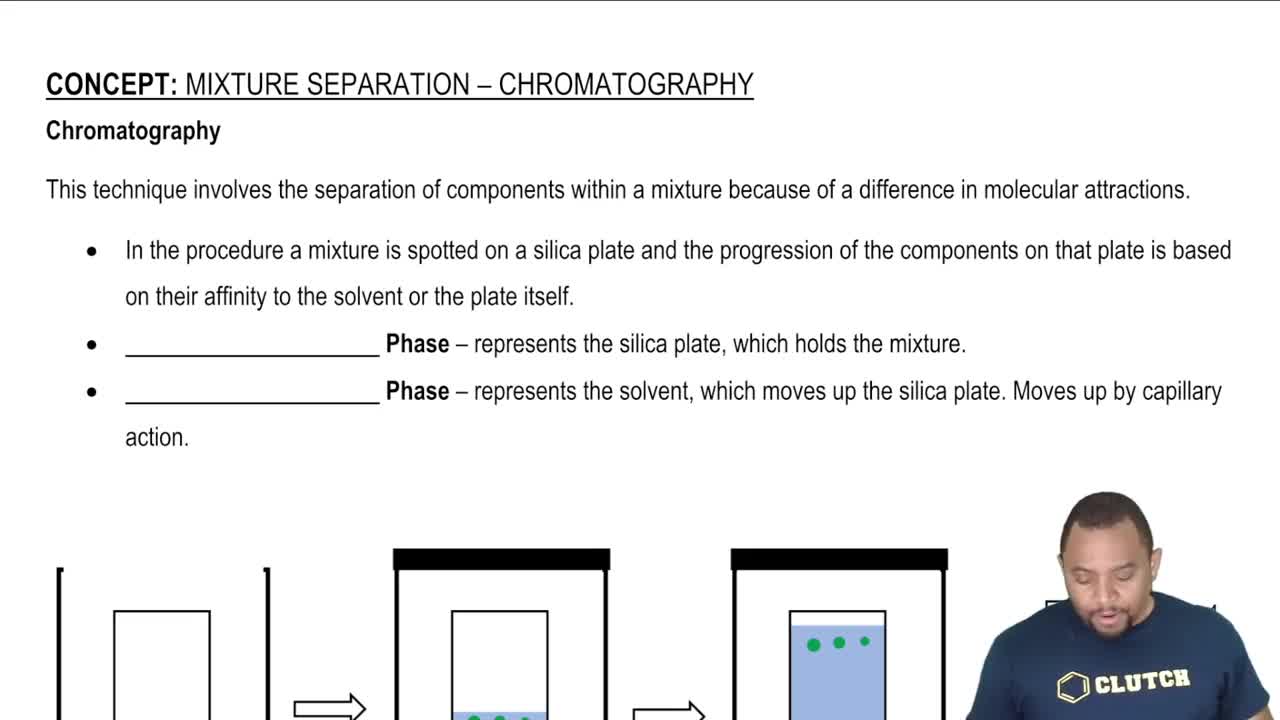
 04:50
04:50