Chromatography is used to separate components of a mixture based on differences in molecular attractions.
What are the two phases involved in chromatography?
The two phases are the stationary phase (silica plate) and the mobile phase (solvent).
What is the stationary phase in TLC chromatography?
The stationary phase is the silica plate, which does not move and holds the mixture.
What is the mobile phase in TLC chromatography?
The mobile phase is the solvent, which moves up the plate by capillary action.
How is a mixture applied to a TLC plate?
A sample of the mixture is spotted onto the TLC plate at a marked starting line.
What is the composition of the solvent used in the described TLC experiment?
The solvent is a mixture of 50% ethanol (slightly polar) and 50% hexanes (non-polar).
How does polarity affect the movement of components on a TLC plate?
Components with greater affinity for the solvent (polarity) travel further up the plate, while those with greater affinity for the stationary phase travel less.
What happens if a component has a greater attraction to the plate than the solvent?
It will move less up the plate, resulting in low movement.
What happens if a component has a greater affinity for the solvent than the plate?
It will move further up the plate, resulting in higher movement.
How is the separation of components visualized on a TLC plate?
The separation is seen as colored dots (e.g., red and green) moving at different rates up the plate.
What is the RF value in chromatography?
The RF value is the ratio of the distance traveled by the compound to the distance traveled by the solvent.
How do you calculate the RF value for a compound?
RF value = (distance traveled by compound) / (distance traveled by solvent).
What were the RF values for the red and green dots in the example?
The red dot had an RF value of 0.50, and the green dot had an RF value of 0.75.
How are RF values used to identify compounds?
RF values are compared to a reference manual to match and identify the compounds represented by the colored dots.
What is the significance of marking positions 1, 2, 3, and 4 on the TLC plate?
Position 1 is the starting line, 2 and 3 are where the red and green dots stopped, and 4 is where the solvent front stopped, used for RF calculations.
 Back
Back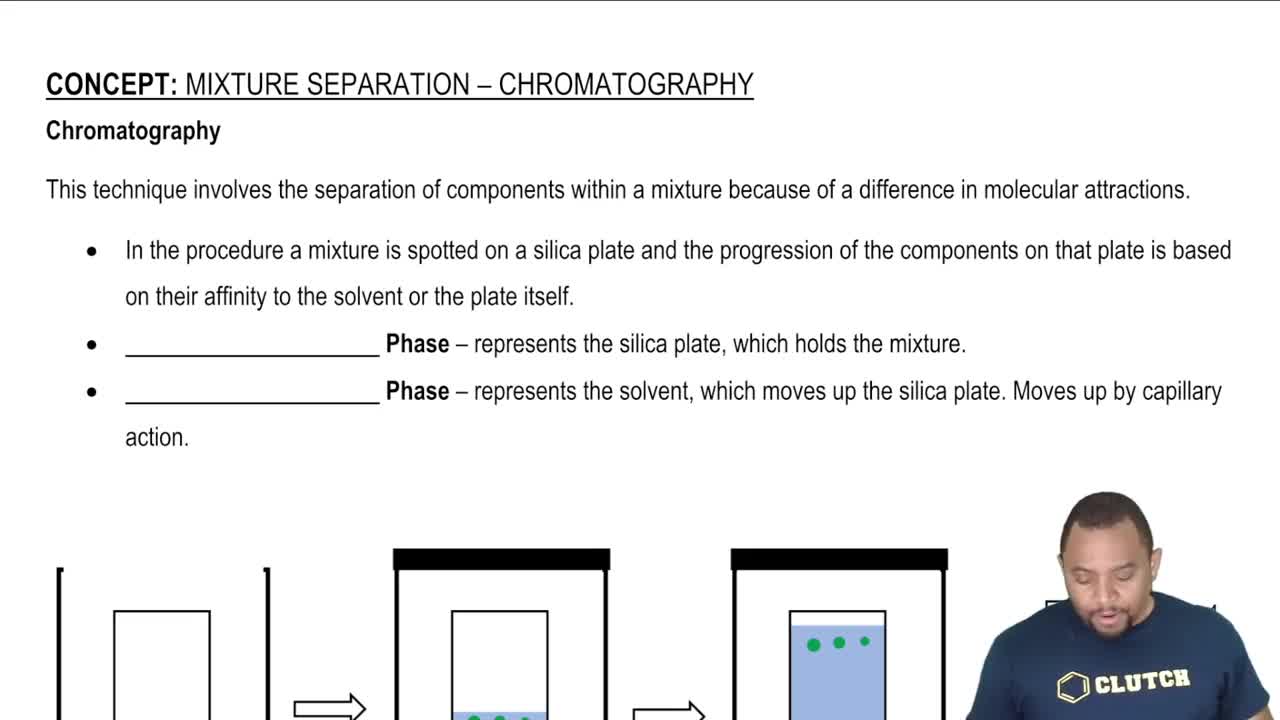
 04:50
04:50