Back

Complete Ionic Equations quiz

Control buttons has been changed to "navigation" mode.
1/15
  • What do complete ionic equations show about aqueous compounds?

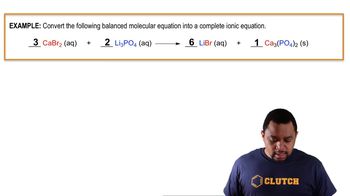
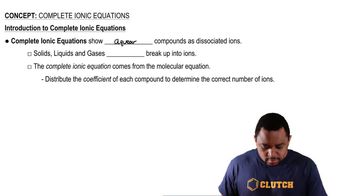
    They show aqueous compounds as dissociated ions.
  • How are solids, liquids, and gases represented in complete ionic equations?

    They remain intact and are not shown as ions.
  • What is the starting point for deriving a complete ionic equation?

    The molecular equation is the starting point.
  • What must you do with coefficients when writing a complete ionic equation?

    Distribute the coefficients to determine the correct number of ions.
  • What do solubility rules help determine in ionic equations?

    They help determine if a compound is aqueous or not.
  • What is a net ionic equation?

    It shows only the ions directly involved in the chemical reaction.
  • What are spectator ions?

    Spectator ions are ions that appear on both sides of the equation and do not participate in the reaction.
  • How do you obtain a net ionic equation from a complete ionic equation?

    By removing the spectator ions from the complete ionic equation.
  • What is the sequence for writing ionic equations?

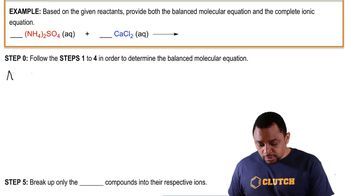
    Start with the molecular equation, then write the complete ionic equation, and finally the net ionic equation.
  • Why do solids, liquids, and gases not break up into ions in ionic equations?

    Because only aqueous compounds dissociate into ions.
  • What is the role of coefficients in ionic equations?

    They indicate the number of each ion present after dissociation.
  • Why are spectator ions excluded from net ionic equations?

    Because they do not participate in the actual chemical reaction.
  • What does a molecular equation show?

    It shows all reactants and products as compounds, not as ions.
  • How do you know which compounds to write as ions in a complete ionic equation?

    Write only aqueous compounds as ions, based on solubility rules.
  • What is the importance of progressing from molecular to complete to net ionic equations?

    It helps in understanding which ions are actually involved in the chemical reaction.