Back

Density of Geometric Objects quiz

Control buttons has been changed to "navigation" mode.
1/15
  • What is the definition of density?

    Density is defined as mass per volume.
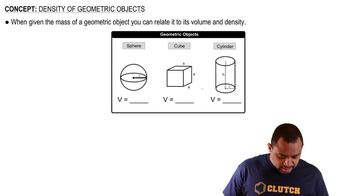
  • How do you calculate the volume of a sphere?

    The volume of a sphere is calculated as 4/3 × pi × radius cubed.
  • What does the variable 'a' represent in the volume formula for a cube?

    'a' represents the length of a side of the cube.
  • What is the formula for the volume of a cube?

    The volume of a cube is a cubed (a^3).
  • Which two measurements are needed to calculate the volume of a cylinder?

    You need the radius and the height of the cylinder.
  • What is the formula for the volume of a cylinder?

    The volume of a cylinder is pi × radius squared × height.
  • Do you need to memorize the volume formulas for geometric objects for exams?

    No, these formulas are usually provided by professors or on formula sheets.
  • How is the radius of a sphere defined?

    The radius is the distance from the center to the edge of the sphere.
  • What is the relationship between mass, volume, and density?

    Density equals mass divided by volume.
  • Why are the volume formulas for geometric objects not in purple boxes in the lesson?

    Because you are not required to memorize them; they will be provided.
  • What geometric objects are commonly discussed when applying density?

    Spheres, cubes, and cylinders are commonly discussed.
  • If you know the mass and volume of an object, how can you find its density?

    Divide the mass by the volume to find the density.
  • What does the formula 4/3 × pi × r^3 calculate?

    It calculates the volume of a sphere.
  • In the context of a cube, what assumption is made about its sides?

    All sides of a cube are assumed to be of equal length.
  • What two variables must be considered when calculating the volume of a cylinder?

    The radius and the height must both be considered.