Back

Disaccharides quiz

Control buttons has been changed to "navigation" mode.
1/15
  • What is a disaccharide?

    A disaccharide is a carbohydrate made of two monosaccharides linked by a glycosidic bond.
  • Which monosaccharides make up maltose?

    Maltose is made up of two D-glucose molecules.
  • What type of glycosidic linkage is found in maltose?

    Maltose contains an alpha 1-4 glycosidic linkage.
  • Where is maltose commonly found?

    Maltose is commonly found in barley and is used in beer production.
  • Which disaccharide is formed from two glucose molecules with a beta 1-4 linkage?

    Cellobiose is formed from two glucose molecules with a beta 1-4 linkage.
  • In what common food can trace amounts of cellobiose be found?

    Trace amounts of cellobiose can be found in honey.
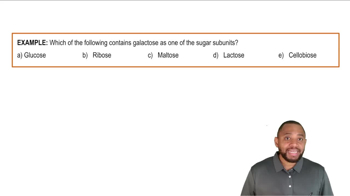
  • Which monosaccharides make up lactose?

    Lactose is made up of D-galactose and D-glucose.
  • What type of glycosidic linkage is present in lactose?

    Lactose contains a beta 1-4 glycosidic linkage.
  • What enzyme is required to digest lactose in humans?

    The enzyme lactase is required to digest lactose.
  • What condition results from a deficiency of lactase?

    A deficiency of lactase results in lactose intolerance.
  • Which monosaccharides make up sucrose?

    Sucrose is made up of D-glucose and D-fructose.
  • What is unique about the glycosidic linkage in sucrose?

    Sucrose has both an alpha 1 and a beta 2 glycosidic linkage.
  • What is the common name for sucrose?

    The common name for sucrose is table sugar.
  • Why can most humans digest lactose but not other beta-linked disaccharides?

    Most humans can digest lactose because they have the enzyme lactase, which breaks the beta 1-4 linkage in lactose.
  • List the four most common disaccharides discussed in the lesson.

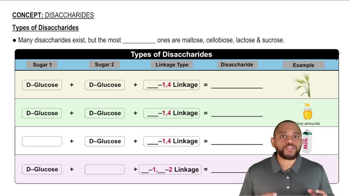
    The four most common disaccharides are maltose, cellobiose, lactose, and sucrose.