Back

Electrolytes (Simplified) quiz

Control buttons has been changed to "navigation" mode.
1/15
  • What is an electrolyte?

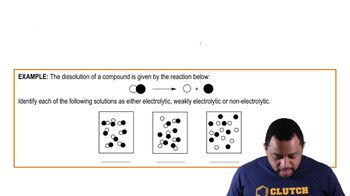
    An electrolyte is a compound that conducts electricity when dissolved or melted into ions.
  • What distinguishes a strong electrolyte from a weak electrolyte?

    A strong electrolyte completely dissociates into ions in solution, while a weak electrolyte only partially dissociates.
  • Give two examples of strong electrolytes.

    Sodium chloride (NaCl) and hydrochloric acid (HCl) are examples of strong electrolytes.
  • What is the degree of dissociation for a strong electrolyte?

    A strong electrolyte dissociates 100% into ions in solution.
  • How does the conductivity of a strong electrolyte compare to a weak electrolyte?

    Strong electrolytes conduct electricity well due to many ions, while weak electrolytes conduct poorly because they produce fewer ions.
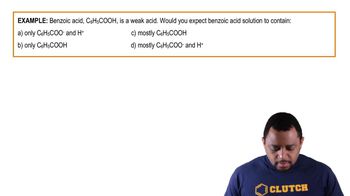
  • What does a double arrow in a chemical equation indicate about the electrolyte?

    A double arrow indicates the compound is a weak electrolyte and the reaction is reversible.
  • Name two examples of weak acids that are weak electrolytes.

    Hydrofluoric acid (HF) and acetic acid (CH3COOH) are weak acids and weak electrolytes.
  • What are some examples of strong bases that are strong electrolytes?

    Sodium hydroxide (NaOH), potassium hydroxide (KOH), and lithium hydroxide (LiOH) are strong bases and strong electrolytes.
  • What is a nonelectrolyte?

    A nonelectrolyte is a compound that does not dissociate into ions in solution and does not conduct electricity.
  • Give two examples of nonelectrolytes.

    Glucose and methanol are examples of nonelectrolytes.
  • How do solubility rules help in classifying electrolytes?

    Solubility rules help determine if a compound will dissolve and dissociate into ions, indicating if it is a strong or weak electrolyte.
  • What is the main difference in the species present in solution for strong and weak electrolytes?

    Strong electrolytes exist almost entirely as ions, while weak electrolytes are mostly molecules with only some ions.
  • Why do nonelectrolytes not conduct electricity?

    Nonelectrolytes do not produce ions in solution, so there are no charged particles to carry electrical current.
  • What is the general formula for sugars, which are common nonelectrolytes?

    The general formula for sugars is CnH2On.
  • What is a key structural feature of alcohols, which are nonelectrolytes?

    Alcohols are covalent compounds with carbon and hydrogen connected to an OH group, and their names typically end in 'ol.'