Back

Empirical Formula definitions

Control buttons has been changed to "navigation" mode.
1/13
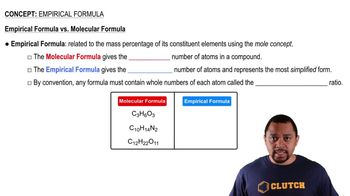
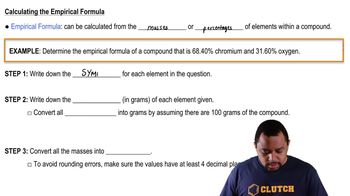
  • Empirical Formula

    Simplest whole-number ratio of elements in a compound, derived by reducing the molecular formula using the greatest common divisor.
  • Molecular Formula

    Actual count of each type of atom present in a compound, showing the true composition without simplification.
  • Whole Number Ratio

    Proportion in which atoms combine in a compound, always expressed as integers for chemical formulas.
  • Mass Percentage

    Relative amount of each element in a compound, expressed as a percent of the total mass.
  • Mole Concept

    Method for relating grams, moles, and particles such as atoms or molecules in chemical calculations.
  • Greatest Common Divisor

    Largest integer by which all subscripts in a molecular formula can be divided to simplify it.
  • Chemical Composition

    Identity and proportion of elements that make up a chemical substance.
  • Atom

    Smallest unit of an element, serving as the basic building block in chemical formulas.
  • Compound

    Substance formed from two or more elements chemically combined in fixed ratios.
  • Simplified Form

    Version of a chemical formula where subscripts are reduced to the lowest possible whole numbers.
  • Subscript

    Number written below and after an element symbol in a formula, indicating the quantity of atoms.
  • Element

    Pure substance consisting of only one type of atom, represented by a unique symbol in formulas.
  • Reduction

    Process of dividing all subscripts in a formula by their greatest common divisor to achieve the simplest ratio.