Skip to main content
GOB Chemistry
My Course
Learn
Exam Prep
AI Tutor
Study Guides
Textbook Solutions
Flashcards
Explore
Try the app
My Course
Learn
Exam Prep
AI Tutor
Study Guides
Textbook Solutions
Flashcards
Explore
Try the app
Back
Enzyme Regulation: Feedback Control definitions
You can tap to flip the card.
Metabolic Pathway
You can tap to flip the card.
👆
Metabolic Pathway
A sequence of biochemical reactions within a cell, each step catalyzed by a specific enzyme, leading to a final product.
Track progress
Control buttons has been changed to "navigation" mode.
1/13
Related flashcards
Related practice
Recommended videos
Enzyme Regulation: Feedback Control quiz
Enzyme Regulation: Feedback Control
15 Terms
Enzyme Regulation: Feedback Control
19. Enzymes
1 problem
Topic
Laura
Enzyme Regulation: Covalent Modification
19. Enzymes
2 problems
Topic
Laura
19. Enzymes
9 topics
15 problems
Chapter
Laura
Guided course
2:08
Feedback Control Example 1
2958
views
2
rank
Guided course
2:50
Feedback Control Concept 1
2907
views
2
rank
Terms in this set (13)
Hide definitions
Metabolic Pathway
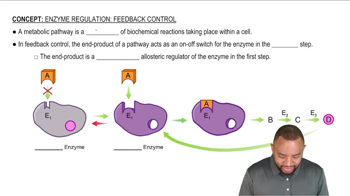
A sequence of biochemical reactions within a cell, each step catalyzed by a specific enzyme, leading to a final product.
Feedback Control
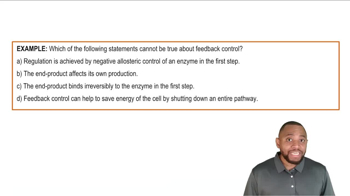
A regulatory mechanism where the end product of a pathway modulates enzyme activity to prevent overproduction.
End Product
The final molecule produced in a metabolic pathway, capable of regulating the pathway's initial enzyme.
Negative Allosteric Regulator
A molecule that binds to an enzyme's allosteric site, altering its shape and reducing its activity.
Active Site
A region on an enzyme where the substrate specifically binds, enabling the catalytic reaction.
Substrate
A reactant molecule that attaches to an enzyme's active site to undergo a chemical transformation.
Enzyme-Substrate Complex
A temporary molecular structure formed when a substrate binds to an enzyme's active site.
Intermediate
A molecule formed between the initial substrate and the final product during a metabolic pathway.
Allosteric Site
A specific region on an enzyme, distinct from the active site, where regulatory molecules can bind.
Inactive Enzyme
A form of an enzyme that cannot bind its substrate due to structural changes, often from regulator binding.
Enzyme Regulation
The control of enzyme activity through mechanisms such as feedback inhibition to maintain cellular balance.
Biochemical Reaction
A chemical process occurring within living cells, often facilitated by enzymes, to sustain life functions.
Cellular Homeostasis
The maintenance of stable internal conditions in a cell, often achieved through regulated metabolic pathways.
 BackBack
 2:08
2:08