Skip to main content
GOB Chemistry
My Course
Learn
Exam Prep
AI Tutor
Study Guides
Textbook Solutions
Flashcards
Explore
Try the app
My Course
Learn
Exam Prep
AI Tutor
Study Guides
Textbook Solutions
Flashcards
Explore
Try the app
Back
Enzyme-Substrate Complex quiz
You can tap to flip the card.
What is the enzyme-substrate complex (ES)?
You can tap to flip the card.
👆
What is the enzyme-substrate complex (ES)?
The enzyme-substrate complex is an intermediate formed when the substrate binds to the enzyme's active site.
Track progress
Control buttons has been changed to "navigation" mode.
1/15
Related flashcards
Related practice
Recommended videos
Enzyme-Substrate Complex definitions
Enzyme-Substrate Complex
12 Terms
Enzyme-Substrate Complex
19. Enzymes
4 problems
Topic
Nicole
Models of Enzyme Action
19. Enzymes
7 problems
Topic
KeyshawnDavis
19. Enzymes
9 topics
15 problems
Chapter
Laura
Guided course
2:32
Enzyme-Substrate Complex Concept 1
3315
views
2
rank
Guided course
1:36
Enzyme-Substrate Complex Example 1
2752
views
2
rank
Terms in this set (15)
Hide definitions
What is the enzyme-substrate complex (ES)?
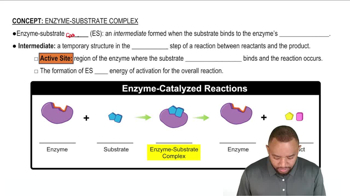
The enzyme-substrate complex is an intermediate formed when the substrate binds to the enzyme's active site.
What type of bond forms between the substrate and the enzyme's active site?
The substrate binds non-covalently to the enzyme's active site.
Why is it important that the substrate binds non-covalently to the enzyme?
Non-covalent binding allows the substrate to easily detach from the enzyme once it is transformed into the product.
What is an intermediate in a reaction sequence?
An intermediate is a temporary structure formed between reactants and products during a reaction.
What effect does the formation of the enzyme-substrate complex have on activation energy?
Formation of the enzyme-substrate complex lowers the activation energy of the reaction.
How does lowering activation energy affect the reaction?
Lowering activation energy speeds up the reaction.
What is the abbreviation for enzyme in the reaction sequence?
The abbreviation for enzyme is 'E'.
What is the abbreviation for substrate in the reaction sequence?
The abbreviation for substrate is 'S'.
What is the abbreviation for the enzyme-substrate complex?
The abbreviation for the enzyme-substrate complex is 'ES'.
What happens to the substrate after it binds to the enzyme?
The substrate is transformed into products and released from the enzyme.
Is the enzyme consumed in the reaction?
No, the enzyme is not consumed; it is reformed and can participate in further reactions.
What is the shorthand notation for the enzyme-catalyzed reaction sequence?
The shorthand notation is E + S → ES → E + P.
Where does the substrate bind on the enzyme?
The substrate binds at the enzyme's active site.
What is the main purpose of the enzyme-substrate complex?
The main purpose is to facilitate the transformation of substrates into products and speed up the reaction.
What happens to the enzyme at the end of the reaction?
The enzyme is reformed and ready to catalyze another reaction.
 BackBack
 2:32
2:32