GOB Chemistry
My Course
Learn
Exam Prep
AI Tutor
Study Guides
Textbook Solutions
Flashcards
Explore
My Course
Learn
Exam Prep
AI Tutor
Study Guides
Textbook Solutions
Flashcards
Explore
Back
The Equilibrium Constant definitions
You can tap to flip the card.
Define:
Equilibrium Constant
You can tap to
flip the card.
👆
Equilibrium Constant
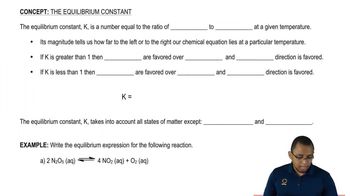
A numerical value representing the ratio of product to reactant concentrations at a specific temperature.
Track progress
Control buttons has been changed to "navigation" mode.
1/13
Related practice
Recommended videos
Guided course
02:50
The Equilibrium Constant Concept 1
Jules
3291
views
20
rank
Guided course
03:43
The Equilibrium Constant Example 1
Jules
2914
views
21
rank
Terms in this set (13)
Hide definitions
Equilibrium Constant
A numerical value representing the ratio of product to reactant concentrations at a specific temperature.
K
A symbol used to denote the equilibrium constant, indicating the extent to which a reaction favors products or reactants.
Ratio
A mathematical comparison of product concentrations to reactant concentrations in a chemical system at equilibrium.
Products
Substances formed as a result of a chemical reaction, found in the numerator when calculating the equilibrium constant.
Reactants
Starting substances in a chemical reaction, found in the denominator when determining the equilibrium constant.
Temperature
A factor that directly influences the value of the equilibrium constant, with increases raising K and decreases lowering K.
Forward Direction
The progression of a reaction toward greater product formation, favored when K is greater than one.
Reverse Direction
The progression of a reaction toward greater reactant formation, favored when K is less than one.
Magnitude
The size or value of the equilibrium constant, indicating the extent to which products or reactants are favored.
Balanced State
A condition where product and reactant concentrations are equal, corresponding to a K value of one.
Solids
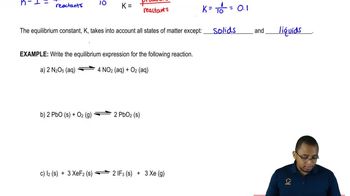
A state of matter excluded from equilibrium constant calculations, as their concentrations do not affect K.
Liquids
A state of matter ignored in equilibrium constant expressions, since their concentrations remain constant.
Concentration
The amount of a substance present in a given volume, used to determine the equilibrium constant.