Back

The Equilibrium Constant quiz

Control buttons has been changed to "navigation" mode.
1/15
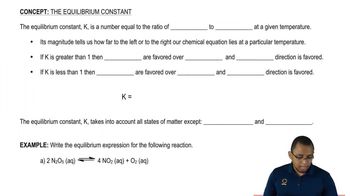
  • What variable is used to represent the equilibrium constant?

    The equilibrium constant is represented by the variable K.
  • How is the equilibrium constant K defined in terms of products and reactants?

    K is defined as the ratio of the concentrations of products to reactants at a specific temperature.
  • How does temperature affect the equilibrium constant K?

    Increasing temperature raises the value of K, while decreasing temperature lowers it.
  • What does a K value greater than 1 indicate about a chemical reaction?

    A K value greater than 1 means the reaction favors the formation of products and proceeds in the forward direction.
  • What does a K value less than 1 indicate about a chemical reaction?

    A K value less than 1 means reactants are favored and the reaction tends to proceed in the reverse direction.
  • What does it mean when K equals 1?

    When K equals 1, the concentrations of products and reactants are equal, indicating a balanced state.
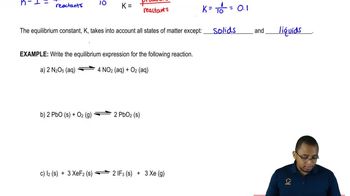
  • Which states of matter are ignored in the calculation of the equilibrium constant K?

    Solids and liquids are ignored in the calculation of K.
  • Why is the equilibrium constant K calculated at a specific temperature?

    Because the value of K changes with temperature, so it must be specified for a particular temperature.
  • If the concentration of products is 10 and reactants is 1, what is the value of K?

    K would be 10, which is greater than 1, indicating products are favored.
  • If the concentration of products is 1 and reactants is 10, what is the value of K?

    K would be 0.1, which is less than 1, indicating reactants are favored.
  • What direction is favored when K is greater than 1?

    The forward direction is favored, leading to more products.
  • What direction is favored when K is less than 1?

    The reverse direction is favored, leading to more reactants.
  • What does the magnitude of K tell us about a chemical reaction?

    It tells us whether the reaction favors products or reactants at a given temperature.
  • Does the equilibrium constant K include the concentrations of solids and liquids?

    No, K does not include the concentrations of solids and liquids.
  • What happens to the equilibrium constant K if temperature decreases?

    The value of K decreases when temperature decreases.