Back

Equivalents quiz

Control buttons has been changed to "navigation" mode.
1/15
  • What does one equivalent (eq) represent in terms of ions in a solution?

    One equivalent equals 1 mole of positive or negative charge contributed by an ion to a solution.
  • How do you calculate the number of equivalents for an ion?

    Multiply the ion's charge by the number of moles of the ion present.
  • Can an equivalent ever be a negative value?

    No, an equivalent can only be a positive value.
  • How many milliequivalents are in one equivalent?

    There are 1,000 milliequivalents in one equivalent.
  • What is the abbreviation for equivalent?

    The abbreviation for equivalent is eq.
  • If you have 1 mole of sodium ion (Na+), how many equivalents is this?

    It is 1 equivalent because the charge is +1 and there is 1 mole.
  • How many equivalents are in 1 mole of Fe3+ ion?

    There are 3 equivalents because the charge is +3 and there is 1 mole.
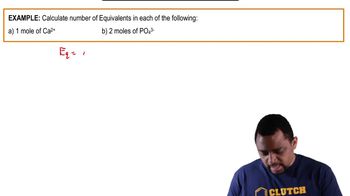
  • What is the formula for calculating equivalents?

    Equivalents = ion charge × moles of ion.
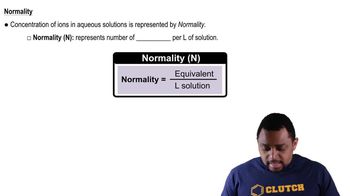
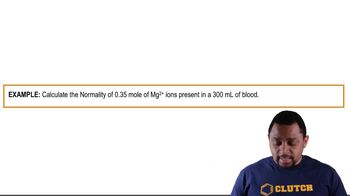
  • What does normality (N) measure in a solution?

    Normality measures the number of equivalents per liter of solution.
  • What is the formula for normality?

    Normality = equivalents / liters of solution.
  • What unit is commonly used to express small amounts of equivalents?

    Milliequivalents are commonly used for small amounts.
  • If you have 2 moles of Ca2+ ions, how many equivalents do you have?

    You have 4 equivalents because 2 (charge) × 2 (moles) = 4.
  • Why are equivalents important in body fluids and intravenous solutions?

    Equivalents measure the individual ion amount present, which is crucial for physiological balance.
  • What variable is used to represent normality?

    The variable 'N' (capital N) is used for normality.
  • How would you convert 0.5 equivalents to milliequivalents?

    Multiply by 1,000, so 0.5 equivalents equals 500 milliequivalents.