Back

Ester Reactions: Esterification definitions

Control buttons has been changed to "navigation" mode.
1/13
  • Esterification

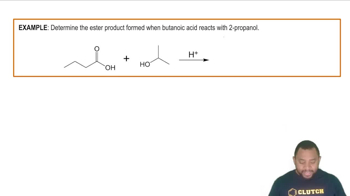
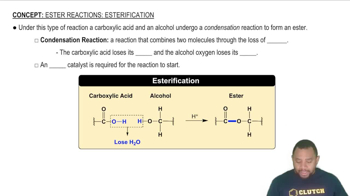
    A process where a carboxylic acid and an alcohol combine, losing water, to produce an ester in the presence of an acid catalyst.
  • Condensation Reaction

    A chemical process joining two molecules with the simultaneous elimination of a small molecule, typically water.
  • Carboxylic Acid

    An organic compound containing a carbonyl and hydroxyl group bonded to the same carbon, serving as a reactant in ester formation.
  • Alcohol

    An organic molecule featuring a hydroxyl group attached to a carbon, acting as a reactant in ester synthesis.
  • Ester

    A compound formed by the reaction of a carboxylic acid and an alcohol, characterized by a carbonyl group linked to an oxygen and another carbon.
  • Water

    A byproduct released during the combination of a carboxylic acid and an alcohol in esterification.
  • H+ Catalyst

    A proton source, often an acid, required to initiate and drive the esterification process.
  • Ester Linkage

    A structural feature where a carbonyl group is bonded to an oxygen, which is further bonded to another carbon atom.
  • Carbonyl Group

    A functional group consisting of a carbon atom double-bonded to an oxygen atom, central to ester structure.
  • Hydroxyl Group

    A functional group composed of an oxygen and hydrogen atom, present in both alcohols and carboxylic acids.
  • Reactant

    A substance, such as a carboxylic acid or alcohol, that undergoes change during the esterification process.
  • Product

    A substance formed as a result of a chemical reaction, such as an ester in esterification.
  • Acid Catalyst

    A substance that increases the rate of esterification by providing protons without being consumed in the reaction.