Skip to main content
GOB Chemistry
My Course
Learn
Exam Prep
AI Tutor
Study Guides
Textbook Solutions
Flashcards
Explore
Try the app
My Course
Learn
Exam Prep
AI Tutor
Study Guides
Textbook Solutions
Flashcards
Explore
Try the app
Back
Experimental Error quiz
You can tap to flip the card.
What are the two main categories of experimental error?
You can tap to flip the card.
👆
What are the two main categories of experimental error?
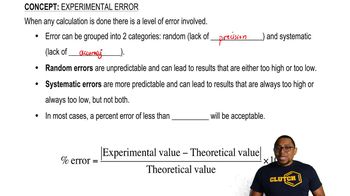
Experimental error is divided into random errors (lack of precision) and systematic errors (lack of accuracy).
Track progress
Control buttons has been changed to "navigation" mode.
1/15
Related flashcards
Related practice
Recommended videos
Experimental Error definitions
Experimental Error
14 Terms
Experimental Error
BONUS: Lab Techniques and Procedures
4 problems
Topic
Distillation & Floatation
BONUS: Lab Techniques and Procedures
5 problems
Topic
BONUS: Lab Techniques and Procedures - Part 1 of 2
5 topics
9 problems
Chapter
BONUS: Lab Techniques and Procedures - Part 2 of 2
2 topics
4 problems
Chapter
Guided course
03:53
Systematic Error
5550
views
7
rank
Guided course
05:50
Experimental Error
5282
views
8
rank
Guided course
02:53
Random Errors
5120
views
3
rank
Terms in this set (15)
Hide definitions
What are the two main categories of experimental error?
Experimental error is divided into random errors (lack of precision) and systematic errors (lack of accuracy).
How do random errors affect measurement results?
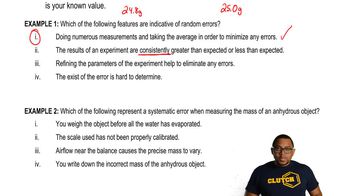
Random errors cause measurement results to fluctuate unpredictably, being either too high or too low.
What is the best way to minimize random errors in experiments?
Taking multiple measurements and averaging them helps reduce random errors.
How are systematic errors different from random errors?
Systematic errors are predictable and consistently result in measurements that are always too high or too low.
What is the relationship between precision and random error?
Random error is associated with a lack of precision, meaning results are not close to each other.
What is the relationship between accuracy and systematic error?
Systematic error is associated with a lack of accuracy, meaning results are not close to the true value.
How can systematic errors be corrected?
Systematic errors can often be corrected by adjusting or refining the experimental setup.
What is the formula for percent error?
Percent error = (|experimental value - theoretical value| / theoretical value) × 100.
What percent error is generally considered acceptable in experiments?
A percent error of less than 10% is generally considered acceptable.
What does a high percent error indicate about your measurements?
A high percent error indicates that your measurements are not very precise.
What is the theoretical value in an experiment?
The theoretical value is the agreed-upon or literature value for an object or measurement.
What is the experimental value in an experiment?
The experimental value is the value you calculate or measure during your experiment.
What are some examples of systematic errors when measuring the mass of an anhydrous object?
Examples include not allowing enough time for the object to dry, not calibrating the scale, or recording the incorrect mass.
Why is airflow near the balance considered a random error?
Airflow is unpredictable and can cause the measured mass to vary, making it a random error.
Why is it sometimes hard to detect systematic errors?
Systematic errors are hard to detect because they consistently give the same incorrect value, making them appear accurate.
 BackBack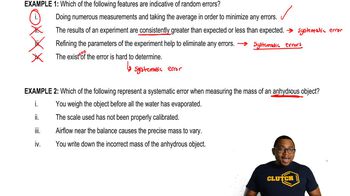
 03:53
03:53