Skip to main content
GOB Chemistry
My Course
Learn
Exam Prep
AI Tutor
Study Guides
Textbook Solutions
Flashcards
Explore
Try the app
My Course
Learn
Exam Prep
AI Tutor
Study Guides
Textbook Solutions
Flashcards
Explore
Try the app
Back
Extraction definitions
You can tap to flip the card.
Extraction
You can tap to flip the card.
👆
Extraction
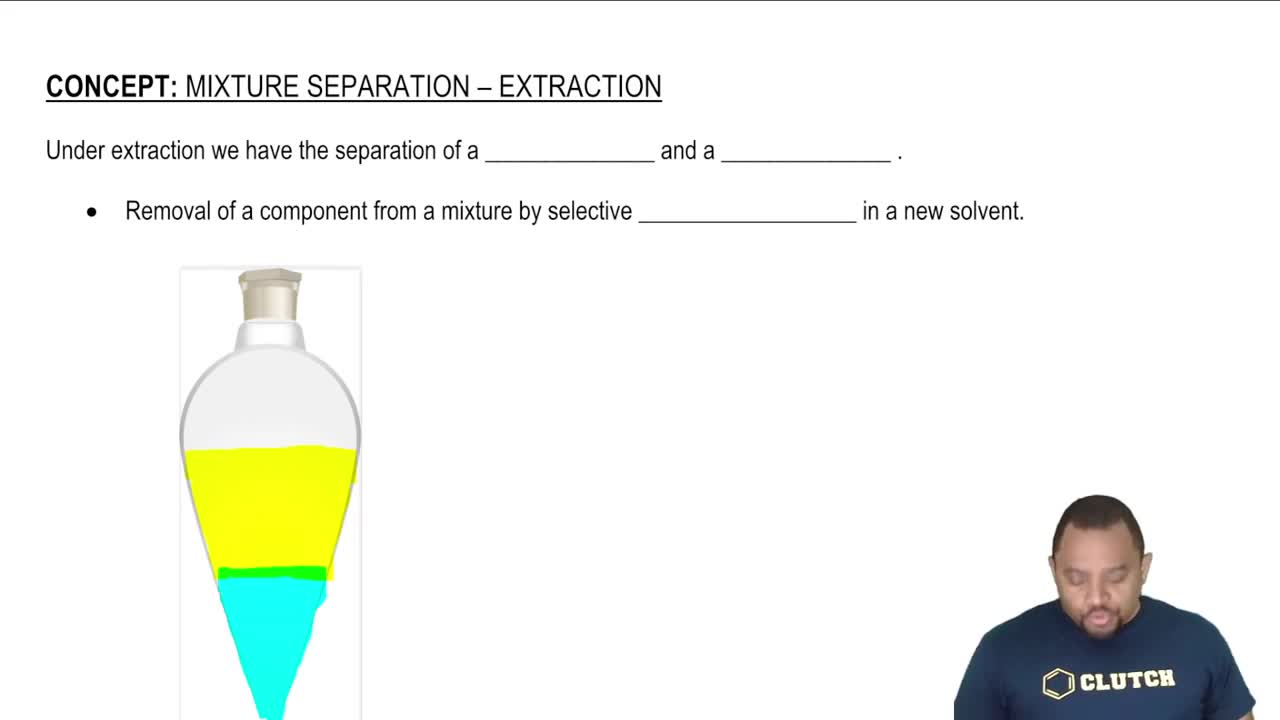
Laboratory technique for separating components of a mixture by exploiting differences in solubility between two immiscible solvents.
Track progress
Control buttons has been changed to "navigation" mode.
1/15
Related flashcards
Related practice
Recommended videos
Extraction quiz
Extraction
15 Terms
Extraction
BONUS: Lab Techniques and Procedures
5 problems
Topic
Test for Ions and Gases
BONUS: Lab Techniques and Procedures
4 problems
Topic
BONUS: Lab Techniques and Procedures - Part 1 of 2
5 topics
9 problems
Chapter
BONUS: Lab Techniques and Procedures - Part 2 of 2
2 topics
4 problems
Chapter
Guided course
08:52
Acid-Base Extraction
5353
views
3
rank
Guided course
05:31
Extraction
4750
views
3
rank
Terms in this set (15)
Hide definitions
Extraction
Laboratory technique for separating components of a mixture by exploiting differences in solubility between two immiscible solvents.
Separatory Funnel
Glassware tool with a stopcock used to mix and separate immiscible liquid layers based on density differences.
Aqueous Layer
Denser, water-based phase in a separatory funnel where polar or charged species preferentially dissolve.
Organic Layer
Less dense, nonpolar solvent phase in a separatory funnel where neutral, nonpolar compounds are more soluble.
Acid-Base Reaction
Chemical process used in extraction to convert neutral compounds into charged ions, altering their solubility.
pH
Scale indicating acidity or basicity, monitored during extraction to ensure complete reaction and separation.
pKa
Numerical value expressing acid strength; lower values indicate stronger acids, guiding extraction sequence.
Acetate Ion
Negatively charged species formed from acetic acid after deprotonation, increasing solubility in water.
Precipitate
Solid formed when a dissolved ion is neutralized, allowing physical separation from the solution.
Venting
Safety procedure in extraction involving controlled release of built-up gas pressure from the separatory funnel.
Sodium Bicarbonate
Weak base commonly used to selectively react with strong acids during stepwise extraction.
Sodium Hydroxide
Strong base used to deprotonate less acidic compounds after initial extraction steps.
Methylammonium Ion
Positively charged species formed when methylamine accepts a proton, increasing its water solubility.
Phenolate Ion
Anionic form of phenol produced after deprotonation, facilitating its migration to the aqueous layer.
Neutralization
Process of converting an ion back to its neutral form, often resulting in precipitation during extraction.
 BackBack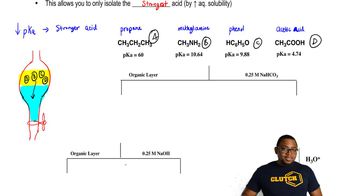
 08:52
08:52