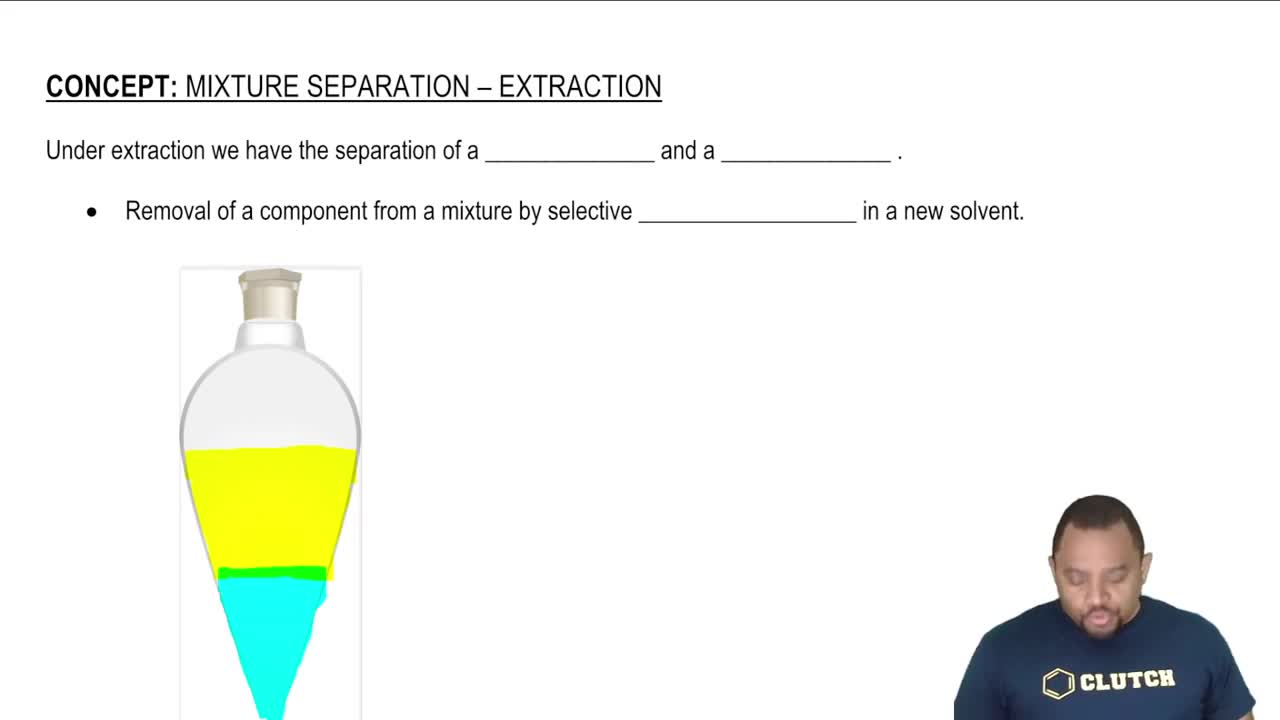
What is the purpose of using a separatory funnel in extraction techniques?
A separatory funnel is used to separate compounds based on their solubility in aqueous and organic solvents, often by exploiting acid-base reactions.
Why does adding a base to an organic layer containing acetic acid cause the acetic acid to move to the aqueous layer?
The base converts acetic acid into the acetate ion, which is polar and thus more soluble in the aqueous (polar) layer.
How can you recover acetic acid from the aqueous layer after extraction?
By adding acid to the aqueous layer, the acetate ion is converted back to neutral acetic acid, which precipitates as a solid.
What is the role of pH strips during an extraction process?
pH strips are used to check if the organic layer is completely basic, ensuring all acetic acid has been neutralized and extracted.
Why is it important to vent the separatory funnel during mixing?
Venting releases built-up gas pressure caused by acid-base reactions during mixing, preventing accidents.
Why is a step-wise approach using weak and then strong bases used in extractions?
A step-wise approach allows selective extraction of compounds based on their acidity, starting with the most acidic.
What happens to a compound when it gains a charge during extraction?
When a compound gains a charge, it becomes polar and moves from the organic layer to the aqueous layer.
How does the pKa of a compound affect its behavior during extraction?
Compounds with lower pKa values are stronger acids and react first with bases, making them more likely to be extracted into the aqueous layer.
What is the effect of adding sodium bicarbonate to a mixture containing acetic acid during extraction?
Sodium bicarbonate, a weak base, reacts with acetic acid to form the acetate ion, which moves into the aqueous layer.
After extracting phenol with a strong base, how is it recovered from the aqueous layer?
Phenol is recovered by adding acidified water, which neutralizes the phenolate ion, causing phenol to precipitate as a solid.
Why do compounds made only of carbon and hydrogen remain in the organic layer during extraction?
Such compounds are nonpolar and do not react with acids or bases, so they stay dissolved in the nonpolar organic layer.
How is methylamine separated from a mixture during extraction?
Methylamine, a weak base, reacts with acid (like HCl) to form a charged methylammonium ion, which moves into the aqueous layer.
What is the final step to recover methylamine as a solid after extraction?
A base is added to the aqueous layer to remove a proton from the methylammonium ion, regenerating neutral methylamine as a solid.
What general principle allows extraction to separate compounds from a mixture?
Extraction relies on changing the solubility of compounds by converting them between charged (polar) and neutral (nonpolar) forms using acid-base reactions.
Why is it important to understand acids, bases, and pKa values for successful extraction?
Knowing acid and base strengths and pKa values helps predict which compounds will react and move between layers during extraction.
 Back
Back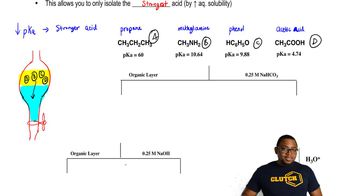
 08:52
08:52