Skip to main content
GOB Chemistry
My Course
Learn
Exam Prep
AI Tutor
Study Guides
Textbook Solutions
Flashcards
Explore
Try the app
My Course
Learn
Exam Prep
AI Tutor
Study Guides
Textbook Solutions
Flashcards
Explore
Try the app
Back
Fatty Acids quiz
You can tap to flip the card.
What is the typical range of carbon atoms found in fatty acids?
You can tap to flip the card.
👆
What is the typical range of carbon atoms found in fatty acids?
Fatty acids usually contain an even number of carbons, typically between 12 and 26.
Track progress
Control buttons has been changed to "navigation" mode.
1/15
Related flashcards
Related practice
Recommended videos
Fatty Acids definitions
Fatty Acids
15 Terms
Fatty Acids
23. Lipids
7 problems
Topic
Ernest
Physical Properties of Fatty Acids
23. Lipids
5 problems
Topic
Ernest
23. Lipids - Part 1 of 3
6 topics
13 problems
Chapter
Ernest
23. Lipids - Part 2 of 3
6 topics
12 problems
Chapter
Nicole
23. Lipids - Part 3 of 3
1 topic
3 problems
Chapter
Guided course
1:06
Fatty Acids Example 2
3169
views
5
rank
Guided course
1:39
Fatty Acids Example 5
3073
views
6
rank
Guided course
1:50
Fatty Acids Concept 5
3136
views
4
rank
Terms in this set (15)
Hide definitions
What is the typical range of carbon atoms found in fatty acids?
Fatty acids usually contain an even number of carbons, typically between 12 and 26.
What does it mean for a fatty acid to be amphipathic?
Amphipathic means the molecule has both a hydrophobic (nonpolar) tail and a hydrophilic (polar) head.
Which part of a fatty acid is hydrophobic and why?
The hydrocarbon tail is hydrophobic because it consists of nonpolar carbons and hydrogens.
What is the hydrophilic part of a fatty acid and what makes it hydrophilic?
The carboxylic acid head is hydrophilic due to its polar nature.
How do saturated and unsaturated fatty acids differ in their bonding?
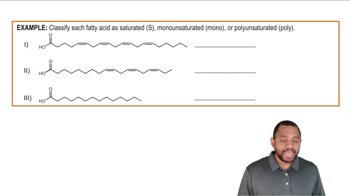
Saturated fatty acids have only single bonds between carbons, while unsaturated fatty acids have at least one double bond.
What do the prefixes 'mono-' and 'poly-' indicate in fatty acids?
'Mono-' means one double bond, and 'poly-' means multiple double bonds.
What is the difference between cis and trans double bonds in fatty acids?
Cis double bonds have substituents on the same side, while trans double bonds have them on opposite sides.
How are omega fatty acids classified?
Omega fatty acids are classified by the position of the first double bond from the methyl end of the chain.
What does 'omega-3' mean in the context of fatty acids?
Omega-3 means the first double bond is at the third carbon from the methyl end.
How is fatty acid shorthand notation written?
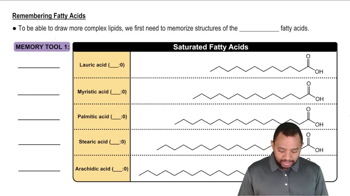
It is written as the number of carbons followed by the number of double bonds, separated by a colon (e.g., 12:0).
What mnemonic helps remember common saturated fatty acids?
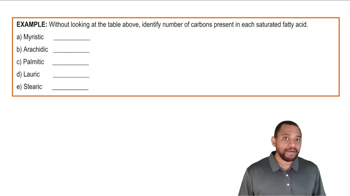
The mnemonic 'Laurie Mystic Palace stores Art' helps recall lauric, myristic, palmitic, stearic, and arachidic acids.
What are the carbon numbers for common saturated fatty acids?
Common saturated fatty acids have 12, 14, 16, 18, and 20 carbons.
What mnemonic is used for common unsaturated fatty acids?
The mnemonic '16 Palms occupy lovely lush, 20 acres' helps remember palmitoleic, oleic, linoleic, linolenic, and arachidonic acids.
Where do the double bonds start in most common unsaturated fatty acids?
For the first four common unsaturated fatty acids, double bonds start at carbon 9 from the carbonyl group.
At which carbon does the first double bond start in arachidonic acid?
In arachidonic acid, the first double bond starts at carbon 5 from the carbonyl carbon.
 BackBack

 1:06
1:06