Back

Gas Evolution Equations (Simplified) definitions

Control buttons has been changed to "navigation" mode.
1/12
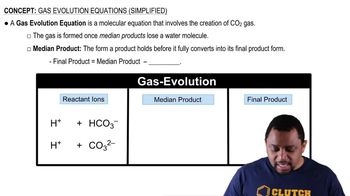
  • Gas Evolution Equation

    A molecular equation where a gas forms from intermediate products losing water, typically resulting in carbon dioxide.
  • Carbon Dioxide

    A gaseous final product formed when an unstable intermediate loses a water molecule during certain reactions.
  • Medium Product

    An intermediate substance that temporarily forms before converting into the final product by losing water.
  • Final Product

    The stable substance obtained after an intermediate loses water, often observed as a gas in these reactions.
  • Water

    A liquid byproduct released when an unstable intermediate decomposes to yield a gaseous final product.
  • Reactant Ion

    A charged particle, such as H+ or bicarbonate, that initiates the process leading to gas formation.
  • H+

    A positively charged ion that reacts with bicarbonate or carbonate to form an unstable intermediate.
  • Bicarbonate Ion

    A negatively charged species that combines with H+ to produce an unstable intermediate in gas evolution.
  • Carbonic Acid

    An unstable intermediate that cannot persist and rapidly decomposes to yield a gas and water.
  • Carbonate Ion

    A negatively charged ion that reacts with H+ to generate an unstable intermediate, leading to gas formation.
  • Molecular Equation

    A chemical representation showing all reactants and products, including intermediates and final substances.
  • Decomposition

    A process where an unstable intermediate breaks down, releasing a gas and a liquid byproduct.